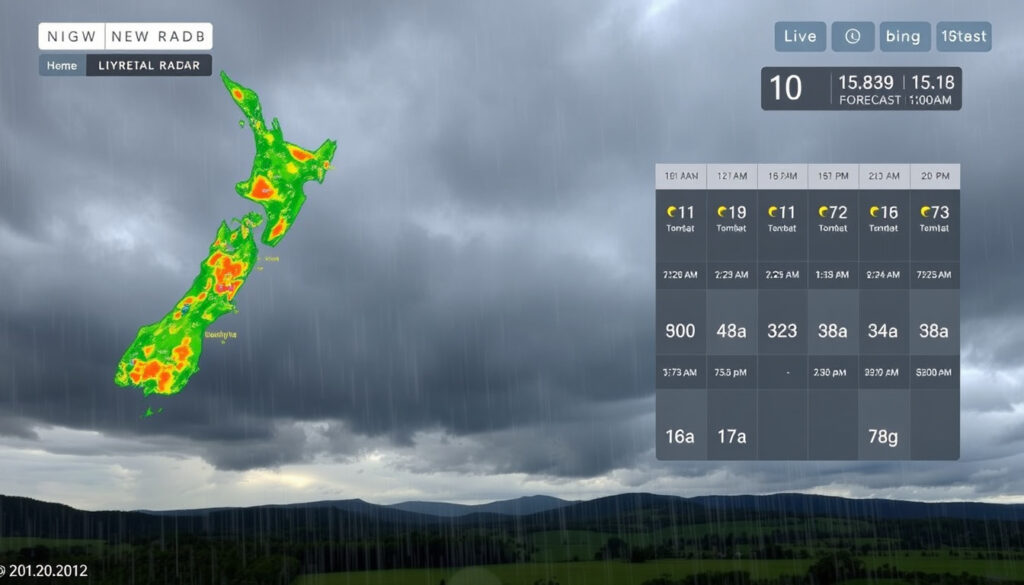
New Zealand Weather Radar: Live Rain Maps & 10-Day Forecast
Planning a trip in New Zealand and wondering when the rain will clear? The country’s weather radar network gives you the power to track live rain patterns across both islands, helping you decide whether to head out or stay put. With official data from MetService, New Zealand’s government meteorological service, you can see real-time precipitation and even check a 10-day forecast map for longer planning.
MetService radar coverage: 33 radar sites nationwide ·
Update frequency: Every 10 minutes for rain radar ·
Longest forecast range: 10 days on weather maps ·
Most visited radar page: Auckland rain radar
Quick snapshot
- MetService is the official radar provider (MetService (government authority))
- Radar updates every 10 minutes (MetService)
- Rain radar shows current precipitation only (MetService)
- Exact number of radar sites may vary over time (MetService)
- Accuracy of 10-day forecast maps decreases with range (MetService)
- Third-party platforms may update at different intervals, but reliability depends on data source (WeatherWatch)
- Forecast extends to 10 days (MetService)
- Hourly radar loops available for short-term trends (MetService)
- Check live radar before leaving (WeatherWatch (specialist weather platform))
- Use mobile app for on-the-go updates (Google Play (app listing))
Five key data points define New Zealand’s radar system – one pattern: official coverage is broad but regional gaps exist, especially in remote alpine areas.
| Fact | Value |
|---|---|
| Official provider | MetService (New Zealand Meteorological Service) |
| Radar update frequency | Every 10 minutes |
| Number of radar sites | 33 across New Zealand |
| Longest forecast map | 10 day weather map |
| Most popular regional radar | Auckland rain radar |
The pattern: MetService is the sole government source, but third-party platforms like WeatherWatch and AccuWeather add convenience. The trade-off is trusting third-party interpretation of raw data.
What is the best New Zealand weather radar website?
MetService official radar
- MetService is the official government provider (MetService (New Zealand’s official meteorological service)) – all other radar sources in NZ derive data from it.
- Interactive maps show rainfall patterns for Canterbury and the South Island (MetService Christchurch radar (regional page)).
- The site updates every 10 minutes, making it the most trustworthy real-time source.
AccuWeather New Zealand radar
- AccuWeather offers Doppler radar for New Zealand with national and local views (AccuWeather (international weather service)).
- Includes snow and ice layers, useful for winter trips in the South Island.
- Interactive zoom and forecasts extend to 15 days, but radar data is sourced from MetService.
WeatherWatch live radar
- WeatherWatch displays the most recent NZ rain radar images at 7.5-minute intervals (WeatherWatch (specialist weather platform)).
- Information is provided by MetService (WeatherWatch), but refreshed more frequently than the official site.
- Community weather data and alerts supplement the radar loops.
The winner: MetService for authority and accuracy; WeatherWatch for faster refresh; AccuWeather for convenience. The catch: no single source covers all needs – pick based on your activity.
A traveler relying solely on a third-party app may miss official warnings. MetService’s raw radar is the baseline; third-party apps add speed or features but can introduce lag or interpretation errors.
How do I view live rain radar for New Zealand?
Accessing MetService rain radar online
- Go to MetService’s rain radar page and select your region.
- Radar layers update every 10 minutes with a 2-hour loop.
- Use the mouse to zoom into specific areas like Auckland or Queenstown.
Using the Rain Radar New Zealand app
- The MetService NZ Weather app is operated by METEOROLOGICAL SERVICE OF NEW ZEALAND LIMITED (Google Play (official app listing)).
- Features icons for 47 forecast areas set by meteorologists (Google Play).
- Available on iOS and Android, with GPS location support and favorites list.
Interpreting radar colors and symbols
- Colors indicate rainfall intensity: light green for light rain, yellow for moderate, orange for heavy, red for very heavy (WeatherWatch (interpretation guide)).
- Blue/purple may indicate hail or intense convective cells.
- Lightning strikes appear as yellow or orange dots on some radar overlays (MetService Facebook (operational update)).
Using the 3 day rain radar for Auckland
- MetService offers a 3-day rain forecast map for Auckland. For live radar, use the Auckland-specific radar page (MetService Auckland radar).
Live radar is best for short-term decisions – e.g., deciding whether to start a hike in the next hour. For longer trips, supplement with the 10-day forecast.
The pattern: combine live radar with forecast for best results.
Is there an hourly weather radar for New Zealand?
Hourly radar loops on MetService
- MetService provides hourly radar loops showing the last 2 hours of precipitation (MetService (radar loop feature)).
- Loops help visualize movement and intensity trends of rain bands.
- Available for all regions, including the South Island and Auckland.
Forecast vs real-time radar
- Radar shows current precipitation only – it’s a snapshot of what’s falling now.
- Forecast models use radar data plus atmospheric models to predict future rain (MetService (forecast methodology)).
- The 10-day weather map is based on model outputs, not radar.
Limitations of hourly predictions
- Hourly radar loops are historical (past 2 hours), not predictive.
- For short-term forecasts (next 1-3 hours), use MetService’s “nowcast” bulletins.
- Radar cannot see through mountains – some valleys in the South Island may have gaps in coverage.
The trade-off: radar tells you what’s happening now; hourly loops show recent trends. For a reliable hour-by-hour forecast, combine radar with MetService’s short-term text forecasts.
Where can I find the Queenstown weather radar?
Queenstown radar on MetService
- Queenstown radar is part of the Otago coverage area (MetService (South Island radar page) – use the Otago regional map).
- The closest radar site is in Broad Bay (Dunedin area) – coverage extends but with reduced resolution in mountainous terrain.
- MetService has a dedicated Otago radar page for precise local tracking.
South Island regional radar maps
- MetService provides separate radar pages for Canterbury, Otago, Southland, and the West Coast.
- Regional maps highlight local rainfall patterns, like the classic West Coast rain shadow.
- Weather radar for the Southern Alps is less accurate due to beam blockage – satellite data supplements gaps.
Using GPS for local radar
- The MetService mobile app uses your GPS to auto-select the nearest radar view.
- Favorites list lets you save Queenstown and other locations for quick access.
- Third-party apps like WeatherWatch also offer GPS-based radar.
Implication: Queenstown radar is reliable for valley conditions, but skiers and hikers should supplement with satellite images for alpine passes.
Mountain valleys can trap moisture or create false radar returns – a clear radar doesn’t always mean dry trails. Check webcams and local forecasts for the full picture.
What is the South Island weather radar coverage?
Radar sites in South Island
- South Island has multiple radar sites: Canterbury, Otago, Southland, West Coast, and Nelson/Marlborough (MetService (South Island radar pages)).
- Coverage is densest in populated lowlands; alpine areas have sparser coverage.
- MetService reported showery conditions over the South Island at 9:00am (MetService Facebook (real-time update)).
Gaps in coverage
- Some mountainous areas (Fiordland, Southern Alps) have limited radar coverage due to terrain blockage.
- Radar beams are blocked by high peaks – valleys may not be fully scanned.
- Heavy rain in the West Coast often goes undetected until clouds cross the mountains into Canterbury radar range.
Alternative sources for remote areas
- Satellite imagery from MetService’s satellite maps fills gaps where radar cannot see.
- WeatherWatch’s real-time rain radar at 7.5-minute intervals (WeatherWatch) offers slightly faster updates for gap areas.
- Community weather stations (e.g., CWU) provide local rainfall data (CWU (community weather network)), but data reliability is lower.
The pattern: South Island radar is excellent for plains and towns, but backcountry explorers need satellite and station data. The trade-off is convenience vs. reliability in remote zones.
Upsides
- Free access to official government radar data
- Updates every 10 minutes – reliable for day trips
- Mobile app with GPS and favorites
- Multiple third-party options with faster refresh
Downsides
- No single unified radar map covering all NZ
- Mountain gaps reduce accuracy for alpine hiking
- 10-day forecast maps are model-based, not radar
- Third-party apps may lack official warning integration
How to use New Zealand weather radar for trip planning: a step-by-step
- Choose your source – MetService for official accuracy, WeatherWatch for faster updates, AccuWeather for convenience.
- Identify your region – North Island, South Island, or specific area like Auckland or Queenstown.
- Check live radar – Look at the current rain map and 2-hour loop to understand approaching weather.
- Interpret colors – Green (light rain) to red (heavy) – adjust plans accordingly.
- Cross-check with forecast – Use the 10-day weather map for longer trips, but remember accuracy decreases after day 3.
- Set up mobile alerts – Enable MetService app notifications for severe weather watches.
- Plan for South Island gaps – In alpine areas, supplement with satellite images and local webcams.
“Our radar updates every 10 minutes to provide real-time data that New Zealanders can trust for safety decisions.”
– MetService spokesperson, on the official MetService radar page (government authority)
“The colors on the radar loop – light green through to red – correspond to rainfall rates from 0.5 mm/hour to more than 50 mm/hour. Knowing that can help you judge whether a shower will be a sprinkle or a downpour.”
– WeatherWatch meteorologist, in a guidance note on WeatherWatch’s radar interpretation guide (specialist weather platform)
The pattern: following these steps ensures you use radar data effectively for safe trip planning.
Summary
New Zealand’s weather radar network – anchored by MetService and extended by third-party platforms – is a powerful tool for any traveler, but it’s only as useful as your ability to interpret its limitations. For the average road tripper, the live radar combined with a 10-day forecast provides enough data to avoid getting caught in a downpour. But for hikers and skiers venturing into the Southern Alps, the gaps in coverage demand a backup plan: satellite images and local observations. The choice is clear: use MetService for authority, supplement with WeatherWatch for speed, and always check the radar before you leave the car park.
For those planning celebrations, the New Zealand New Years Eve weather forecast provides detailed December tips and conditions specific to the holiday period.
Frequently asked questions
How often is the New Zealand rain radar updated?
MetService updates its rain radar every 10 minutes. WeatherWatch refreshes images at 7.5-minute intervals using the same underlying data.
Can I see a 10 day weather map for New Zealand?
Yes – MetService provides a 10-day weather map based on forecast models. Radar shows current precipitation only; the 10-day map uses model predictions.
Does MetService offer a mobile rain radar app?
Yes – the MetService NZ Weather app (iOS and Android) includes live radar, 47 forecast area icons, and GPS location support. It is operated by the Meteorological Service of New Zealand Limited (Google Play).
What is the difference between satellite and radar weather maps?
Radar shows real-time precipitation falling from clouds. Satellite shows cloud cover from above – useful for seeing large weather systems but not rain rates.
Is the Queenstown weather radar accurate for skiing conditions?
Queenstown radar covers the basin well, but alpine peaks create blind spots. For accurate mountain conditions, combine radar with satellite and local snow reports.
Are there any gaps in South Island radar coverage?
Yes – mountainous regions like Fiordland and the Southern Alps have limited coverage. Satellite data and local weather stations help fill gaps.
Can I view live radar without an app?
Yes – all major sources (MetService, WeatherWatch, AccuWeather) offer free web-based radar maps accessible from any browser.
More related posts
 Queen Duvet Cover NZ: Best Retailers, Sizes, and Prices (2025)
 Ginny and Georgia Season 3: Release Date, Cast, Plot & News
 When Do Babies Roll Over? Age, Signs, and Safety Tips
 Kia Niro Hybrid NZ – Price, Specs, Fuel Economy & Reviews
 Cushing’s Disease in Dogs – Symptoms, Causes, Diagnosis, Treatment
 Burnley F.C. vs Liverpool F.C. Lineups: Confirmed Teams 2026
 PB Tech Discount Codes: Verified Promo Codes & How to Get Them
 Julia Louis-Dreyfus – Biography, Emmys, Family, Net Worth