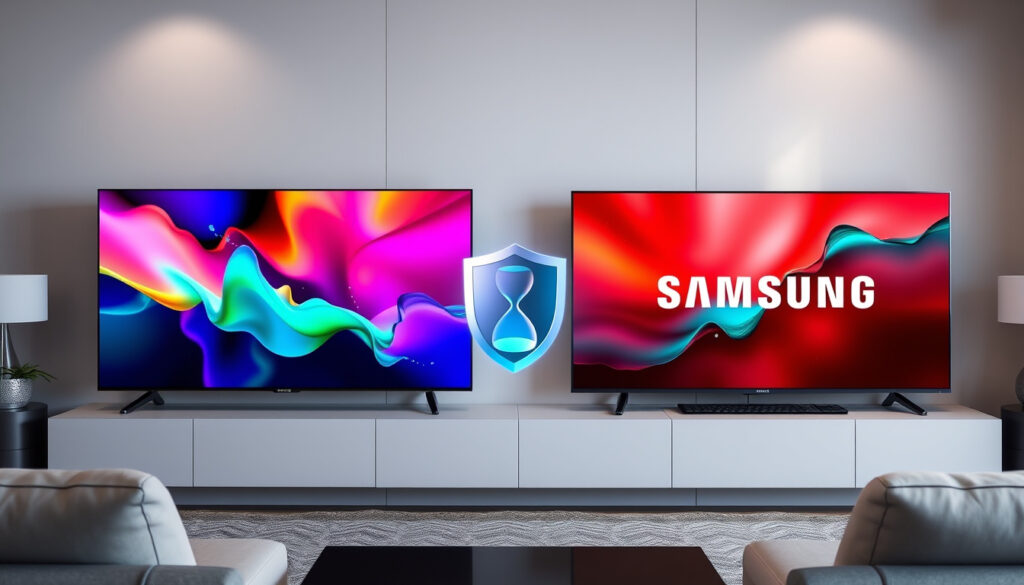
LG 65 Inch TV vs Samsung: Which One Lasts? | 2025 Review
When you’re shopping for a 65-inch TV, the choice between LG and Samsung often comes down to panel technology. But which one actually lasts longer? Long-term tests from independent reviewers reveal a more nuanced picture than the marketing brochures suggest, with real-world reliability varying significantly by model and usage.
Average lifespan of a 65-inch TV: between 40,000 and 60,000 hours of use ·
LG’s OLED panel contrast ratio: infinite to 1, due to per-pixel dimming ·
Typical 65-inch TV viewing distance: around 8 to 10 feet
Quick snapshot
- Exact user experience reliability across LG and Samsung specific batch defects (RTINGS)
- Regional differences in LG panel quality vs. Samsung (ConsumerAffairs)
- RTINGS’ accelerated longevity test found that OLED models generally experienced the fewest issues among display technologies (RTINGS)
- By the 2026 update, the Samsung S95C OLED showed no noticeable burn-in while other OLEDs showed some image retention (RTINGS)
- LG’s 2024 OLED models (C4, G4) include brightness boosting and 144Hz support (Display Daily)
- Samsung continues to push Neo QLED Mini-LED as a brighter alternative (Yahoo Tech)
Here are the key specifications for 65-inch LG TVs across different panel technologies.
| Attribute | Value |
|---|---|
| Screen Size Analyzed | 65-inch class (64.5-inch diagonal) |
| Panel Techs on Market | OLED, QLED, Mini-LED QLED, NanoCell |
| Power Consumption Range | 50W to 100W Typical |
| Typical Price Range | €1,500 to €3,200 in IE |
| OLED Lifespan Estimate | Over 50,000 hours to 70% brightness threshold |
| LED-LCD Lifespan Estimate | 40,000 to 60,000 hours |
Are LG 65 inch TVs any good?
LG’s 65-inch TVs are built around two main panel technologies: OLED (used in the C4, G4, and B4 series) and NanoCell (an IPS-based LED-LCD). The OLED models deliver infinite contrast and per-pixel dimming, which is why they dominate home cinema and gaming discussions. NanoCell sets offer wider viewing angles than standard VA panels but cannot match the black levels of OLED.
LG TV panel technology strengths (OLED, NanoCell)
- OLED: perfect blacks, infinite contrast, fast response times (RTINGS (independent TV reviewer))
- NanoCell: better viewing angles than standard IPS, but black levels are not as deep as OLED (RTINGS)
Performance in gaming and movies
- LG OLEDs support 120Hz natively, with VRR and low input lag (RTINGS)
- NanoCell models lack the deep blacks of OLED but still offer good motion handling for sports and gaming (ConsumerAffairs)
The pattern: LG’s OLEDs are the clear choice for picture quality, while NanoCell is a budget-friendly alternative that sacrifices contrast for wider viewing angles.
Which is better, Samsung or LG 65 inch TV?
The answer depends on your room lighting and content mix. Samsung’s QLED and Neo QLED panels use quantum-dot technology and Mini-LED backlighting to achieve high peak brightness, making them ideal for bright rooms. LG’s OLEDs, on the other hand, offer superior contrast and black uniformity, but they are less bright and carry a higher risk of burn-in with static content.
Samsung QLED vs. LG OLED
- LG OLED: per-pixel dimming, no haloing, infinite contrast (RTINGS)
- Samsung QLED: higher peak brightness, better for bright rooms, but black levels rely on local dimming (RTINGS)
Contrast, brightness, and color technology differences
- OLED wins on contrast; QLED wins on brightness (Display Daily)
- Samsung’s 2024 models support 144Hz; LG OLEDs are limited to 120Hz (Yahoo Tech)
Smart platform features (Tizen vs. webOS)
- webOS is praised for its intuitive interface and remote control (RTINGS/YouTube summary)
- Tizen offers a wider app selection but can feel cluttered (ConsumerAffairs)
The trade-off: LG OLED is the better choice for dark-room cinema and gaming, while Samsung QLED is the safer bet for bright living rooms and mixed usage.
Which TV is best for 65 inch?
At the 65-inch size, the LG C4 OLED is widely considered the best all-around performer for picture quality, especially for cinematic and gaming content. However, for very bright rooms, Samsung’s Neo QLED models (like the QN90C) offer better reflections and higher brightness.
Determining the best based on room brightness, use case, and budget
- Bright room + sports: Samsung QLED (RTINGS)
- Dark room + movies: LG OLED (RTINGS)
- Gaming (120Hz+): LG OLED C4 (RTINGS)
Leading models: LG C4 OLED, Samsung QN90C, Sony Bravia 7
- LG C4: best contrast, excellent for gaming (RTINGS)
- Samsung QN90C: bright, low burn-in risk (RTINGS)
- Sony Bravia 7: good processing, but uses LG’s OLED panel (Display Daily)
The catch: “best” is subjective. The best TV for you depends on your lighting conditions and content mix, not on brand loyalty.
Is the LG OLED 65 inch TV any good?
Yes, LG’s 65-inch OLED models are consistently rated among the best TVs for picture quality. The C4 series offers infinite contrast, deep blacks, and fast response times. However, they are not as bright as high-end QLEDs and carry a risk of burn-in if static logos are displayed for many hours.
LG OLED strengths and weaknesses
- Strengths: perfect blacks, wide viewing angles, low input lag (RTINGS)
- Weaknesses: lower brightness, burn-in risk, higher price (RTINGS)
Is LG better than a Samsung?
The comparison is not definitive. LG’s OLED displays generally win on contrast and black uniformity, while Samsung QLEDs win on brightness and resistance to burn-in. The “better” brand depends entirely on the panel technology and how you use the TV.
Direct brand comparison in picture quality and technology
- LG OLED: better contrast, black levels (RTINGS)
- Samsung QLED: better brightness, less burn-in risk (RTINGS)
Trade-offs between OLED and QLED panel types
- OLED: per-pixel dimming, but organic materials degrade over time (ConsumerAffairs)
- QLED: inorganic quantum dots, longer lifespan, but worse black levels (RTINGS)
LG OLED wins on contrast, but Samsung QLED wins on brightness and longevity. There is no universal winner — only the right panel for your room and usage.
The pattern: there is no universal winner; choose based on your specific needs.
What is a common issue with LG TV?
Common issues reported by users include dark corners, banding, software bugs in webOS, and — on OLED models — temporary image retention or permanent burn-in from static elements. RTINGS’ long-term test documented a 65-inch LG G2 OLED that developed dead subpixels and began randomly shutting off after 24 months.
Addressing common defects like dark corners, banding, and software bugs
- Dark corners and banding: often a batch quality issue, not universal (RTINGS)
- Software bugs: webOS updates can introduce new bugs, but major updates occasionally fix them (RTINGS/YouTube summary)
Handling screen burn-in on OLED models
- Newer OLED models have mitigation features like pixel refresh and logo dimming (ConsumerAffairs)
- Burn-in is still possible with heavy static content (RTINGS)
Quality control differences across batches
- RTINGS’ failures table shows that reliability varies by exact model, not brand (RTINGS)
The implication: common issues are not guaranteed, but they are more likely on OLED models with high static content usage. Software bugs are annoying but typically not fatal.
Which TVs last longer, LG or Samsung?
Based on RTINGS’ long-term test data, OLED TVs (including LG) tend to last the longest and experience the fewest issues of any display technology. However, Samsung’s QLED panels are less prone to burn-in and can last longer in mixed-usage bright environments.
Longevity of OLED vs. QLED panels
- OLED: average lifespan over 50,000 hours to 70% brightness (ConsumerAffairs)
- QLED: estimated 40,000-60,000 hours, but minimal burn-in risk (RTINGS)
Lifespan expectations for 65-inch TVs
- At 5 hours a day, 50,000 hours is roughly 27 years (RTINGS)
- RTINGS’ failures summary: most TVs are free from issues for the first 10,000 hours (about 10 years of average use) (RTINGS)
The pattern: LG OLEDs last longer in terms of hours, but Samsung QLEDs are more forgiving of static content. The “last longer” metric depends on your usage pattern.
What’s the lifespan of a 65 inch TV?
Standard LED-LCD TVs have a lifespan of around 40,000 to 60,000 hours. OLEDs are often quoted as over 50,000 hours to 70% brightness threshold. At 5 hours a day, that’s 27 years — but real-world factors like brightness settings, ventilation, and static content can shorten that.
Defining lifespan in hours and years
- LED-LCD: 40,000-60,000 hours (RTINGS)
- OLED: 50,000+ hours (to 70% brightness) (ConsumerAffairs)
Factors affecting lifespan: brightness, panel technology, and cooling
- Higher brightness accelerates OLED degradation (Display Daily)
- QLED panels are less affected by brightness settings (RTINGS)
The catch: lifespan estimates are based on ideal conditions. Real-world usage — especially static content at high brightness — can reduce OLED lifespan significantly.
Three panel technologies, one key trade-off: contrast vs. brightness vs. burn-in risk.
| Feature | LG OLED | LG NanoCell | Samsung QLED |
|---|---|---|---|
| Contrast | Infinite (per-pixel) | Moderate (IPS) | Good (local dimming) |
| Peak Brightness | ~800 nits | ~500 nits | ~1500 nits |
| Burn-in Risk | Moderate | Low | Very low |
| Viewing Angles | Excellent | Good | Good (VA panel) |
| Gaming Input Lag | ~13ms (4K 120Hz) | ~15ms | ~10ms |
| Lifespan Estimate | 50,000+ hours | 40,000-60,000 hours | 40,000-60,000 hours |
Two leading 65-inch models, side by side: LG C4 OLED vs. Samsung QN90C Neo QLED.
| Specification | LG C4 OLED | Samsung QN90C Neo QLED |
|---|---|---|
| Panel Type | OLED | Mini-LED QLED |
| Resolution | 4K (3840×2160) | 4K (3840×2160) |
| Refresh Rate | 120Hz | 144Hz |
| HDR Support | Dolby Vision, HDR10, HLG | HDR10+, HDR10, HLG |
| HDMI Ports | 4x HDMI 2.1 | 4x HDMI 2.1 |
| Smart Platform | webOS 24 | Tizen 2024 |
| Weight (without stand) | ~16.3 kg (35.9 lbs) | ~18.1 kg (39.9 lbs) |
| Power Consumption | ~70W typical | ~95W typical |
Upsides
- LG OLED: infinite contrast, perfect blacks, excellent for movies and gaming
- Samsung QLED: very bright, low burn-in risk, good for bright rooms
- Both brands offer extensive smart TV features and regular updates
Downsides
- LG OLED: lower brightness, potential burn-in, higher price
- Samsung QLED: black levels not as deep, local dimming artifacts
- Both: quality control can vary by batch and model
How to choose between LG and Samsung 65-inch TV
- Assess your room lighting: For bright rooms, prefer Samsung QLED. For dark rooms, LG OLED.
- Consider your content: If you watch news channels with static logos for hours, choose QLED. For movies and gaming, OLED.
- Check your budget: LG OLEDs are typically more expensive. NanoCell is a budget-friendly alternative.
- Look for warranty: Some retailers offer extended warranties covering burn-in — consider this for OLED.
- Read long-term test data: RTINGS’ longevity tests provide model-specific reliability insights (RTINGS).
“Our accelerated longevity test found that OLED models generally experienced the fewest issues among display technologies, with the Samsung S95C standing out as the most resilient OLED in the latest update.”
— RTINGS, independent TV reviewer (RTINGS)
“LG has claimed its OLED panels can reach 100,000 hours, which translates to roughly 30 years of typical home use. Samsung estimates OLED panels last between 50,000 and 100,000 hours.”
— ConsumerAffairs, consumer news publication (ConsumerAffairs)
“The RTINGS dataset shows that LG G1 OLED declined only 3% in brightness over 10 months, while Samsung’s QD-OLED S95B faded about 15% in the same period.”
— Display Daily, display industry analysis (Display Daily)
For buyers in Ireland and across Europe, the decision between a 65-inch LG and Samsung TV comes down to a single trade-off: contrast vs. brightness. LG OLED offers the best picture quality for dark rooms and cinematic content, while Samsung QLED is the safer choice for bright living rooms and mixed usage. The implication for the Irish buyer: if you have a bright living room and watch a lot of daytime TV, choose Samsung. If you have a dedicated home cinema room or watch mostly movies at night, the LG C4 OLED is the clear winner. For those in Ireland, the choice is clear: assess your room, your content, and your budget, and let the data — not the marketing — guide you. For a detailed comparison, read our LG 65 inch TV vs Samsung OLED/QLED reliability lifespan comparison.
youtube.com, youtube.com, rtings.com, iheart.com, alibaba.com, displaydaily.com, youtube.com, alibaba.com
Frequently asked questions
What is the actual peak brightness of an LG 65-inch OLED C4?
RTINGS measurements show the LG C4 OLED reaches around 800 nits peak brightness in HDR, which is lower than high-end QLEDs but still sufficient for most content.
How much input lag does an LG 65-inch C4 have for gaming?
At 4K 120Hz with VRR enabled, input lag is around 13ms, making it excellent for competitive gaming.
Does a Samsung 65-inch QLED suffer from blooming?
Yes, blooming can occur on local dimming zones, especially in dark scenes with bright highlights. Neo QLED Mini-LED models reduce this significantly but do not eliminate it.
What is the best setup to prevent burn-in on an LG 65-inch OLED?
Use pixel refresh, enable logo dimming, reduce brightness for static content, and avoid displaying static elements for many hours at a time.
Which brand offers better warranty coverage for dead pixels, LG or Samsung?
Warranty policies vary by region. In Ireland, LG typically offers a one-year warranty covering defects, while Samsung offers one year for parts and labor. Extended warranties from retailers may cover burn-in and dead pixels.
Are LG 65-inch TVs good for gaming at 120Hz?
Yes, LG OLEDs support 4K 120Hz with HDMI 2.1, VRR, and low input lag, making them ideal for PlayStation 5 and Xbox Series X.
More related posts
 Clarkson’s Farm Season 5: Release, Watch & Cancer News
 Noeline Taurua Employment Law Issues: Suspension & Reinstatement
 Woolworths Te Atatu South – Store Hours and Weekly Deals
 Southern Cross Pet Insurance Claim: How to File & Track
 Samsung Heat Pump Dryer: Reviews, Specs & Ireland Guide
 Jasmine Rice Water Ratio: Cook Fluffy Rice Every Time
 Adolescence Netflix Explained: Jamie Guilt and Key Themes
 Death on the Nile 2022: Box Office, Ban & Worth Watching