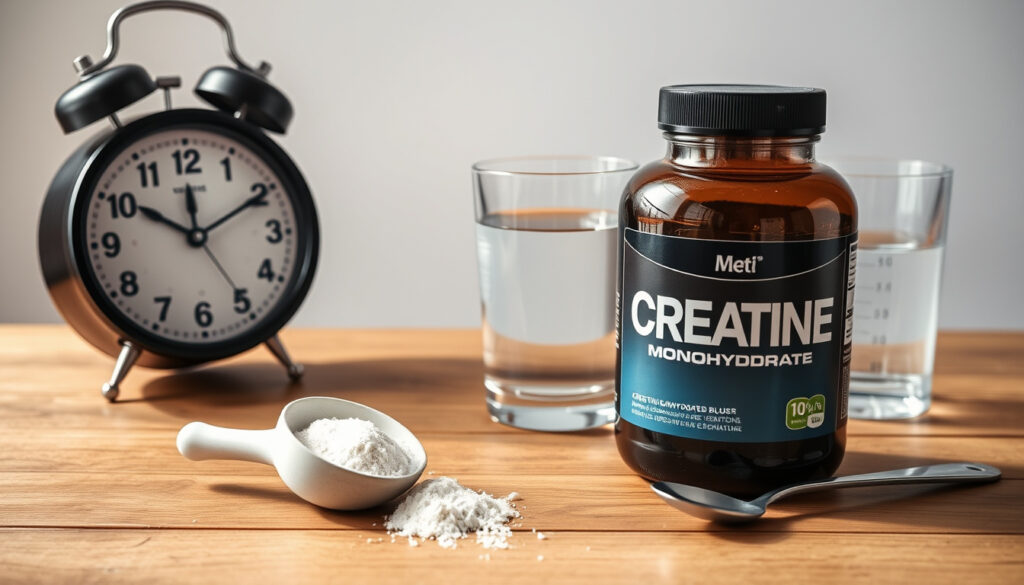
Best Time to Take Creatine: Timing, Dosage & Safety Guide
Anyone who’s started a creatine routine has probably wondered whether to take it before or after a workout, but a 2022 review in Frontiers in Sports and Active Living concluded that timing around exercise is not a major factor. This guide sorts through the latest research on timing, dosage, hydration, and safety so you can focus on what actually works.
Creatine Monohydrate Purity Typically Required: 99.9% ·
Standard Daily Maintenance Dose: 3–5g ·
Time to Muscle Saturation (Loading Phase): 5–7 days ·
Water Weight Reported in First Week: 2–4 lbs ·
Common Mixing Liquid Volume per Dose: 8–12 oz (240–360 ml)
Quick snapshot
- Creatine monohydrate is safe for healthy adults (European Commission Scientific Committee on Food)
- Loading saturates muscles in 5–7 days (PubMed Central review)
- Common dose 3–5g maintenance (European Commission Scientific Committee on Food)
- Whether pre vs post workout timing makes a clinically meaningful difference (Frontiers review)
- Whether post-exercise creatine is superior to pre-exercise for muscle gain (Ribeiro meta-analysis)
- Direct effect on sleep quality (Frontiers review)
- 2021: Ribeiro meta-analysis suggests post-exercise creatine may be superior for muscle gain
- Future research may clarify pre vs post timing and sleep effects (Frontiers review)
Six key facts that summarize the essentials for anyone considering creatine supplementation.
| Label | Value |
|---|---|
| Daily Maintenance Dose | 3–5g |
| Time to Saturation | 5–7 days loading |
| Water per Dose | 8–12 oz (240–360 ml) |
| Empty Stomach Safety | Generally ok, may cause mild stomach upset |
| Weight Gain (First Week) | 2–4 lbs water retention |
| Notable Contraindication | Kidney disease |
Is it better to take creatine before or after a workout for muscle gain?
Timing around exercise: what research says
- A 2021 review in PubMed Central stated that adapting creatine timing to the time of training is not supported by solid evidence.
- A 2022 Frontiers study found that timing of creatine monohydrate did not exert additional influence on resistance-training adaptations over 8 weeks.
- Consistency matters more than exact timing.
Post-workout vs pre-workout absorption
- A 2013 randomized study reported a small advantage for post-workout creatine for body composition and strength (PubMed).
- A newer 2026 pilot study suggested that a single creatine dose taken before strength exercise was associated with greater acute performance (PubMed Central).
- Both approaches are effective; the difference may be small.
How to take creatine for beginners?
Recommended dosage: loading vs maintenance
- Standard loading: 20g/day (4×5g) for 5–7 days (PubMed Central review).
- Maintenance: 3–5g/day.
- No need for cycling.
Mixing instructions
- Mix with 8–12 oz water or juice.
- Combine with carbohydrates to improve absorption.
Daily schedule for first week
- Divide 20g into 4 doses spread throughout the day.
- Take with meals to reduce stomach upset.
- After loading, switch to 3–5g once daily.
Loading is optional but speeds saturation. The European Commission’s Scientific Committee on Food advises that lower doses of 3g/day are unlikely to pose any risk for healthy adults (European Commission Scientific Committee on Food). Beginners should start with 3–5g daily and skip the loading phase if they prefer a slower approach.
The implication: skipping the loading phase is a perfectly valid strategy for beginners.
Do and don’ts with creatine?
What to avoid mixing with creatine
- Avoid mixing with caffeine in high doses? Mixed evidence – some studies suggest caution, but no strong contraindication.
- Do not take with alcohol.
Safe combinations
- Carbohydrates enhance creatine uptake.
- Protein shakes are fine.
Common mistakes
- Do not exceed recommended dosage.
- Do not mix with hot liquids (may degrade creatine).
- Do not skip hydration.
The pattern: most mistakes come from overcomplicating a simple supplement. The Spanish Scientific Committee on food supplements accepts up to 3g/day for healthy adults, reinforcing that moderate use is well-established.
Does creatine affect sleep?
Reported sleep disturbances
- Anecdotal reports of vivid dreams, insomnia.
- No strong clinical evidence of consistent sleep disruption.
Mechanisms and individual variability
- Possible influence via neurotransmitter balance or hydration changes.
- Individual responses vary; some report no effect.
“The evidence on creatine and sleep is thin. Most people don’t notice changes, but a subset report vivid dreams or difficulty falling asleep.” — Houston Methodist dietitian, 2024 safety guide
The implication: if you notice sleep issues, try taking creatine earlier in the day. The trade-off is minor — moving the dose to morning often resolves the problem.
How much water should I drink with creatine?
Hydration guidelines while supplementing
- Aim for 8–12 oz (240–360 ml) per 5g dose.
- General hydration: 1.5–2L daily minimum for most adults.
- Athletes need 3L+.
Is 2L per day enough?
- 2L may be sufficient for sedentary individuals, but athletes need more due to sweat losses.
- Creatine increases water retention in muscles, so adequate fluid intake supports kidney function.
Creatine pulls water into muscle cells. If you don’t drink enough, you risk dehydration, especially during exercise. The European Commission’s Scientific Committee on Food notes that lower doses are safe, but hydration is essential.
What this means: adequate hydration is critical to avoid dehydration when muscles are pulling in water.
Who should avoid taking creatine?
Medical conditions that require caution
- Avoid if pre-existing kidney disease.
- Caution with diuretics and NSAIDs (theoretical risk).
Age restrictions
- Not recommended under 18 without medical advice.
Medication interactions
- Diuretics may increase risk of dehydration.
- NSAIDs combined with creatine may stress kidneys (theoretical).
“Creatine is safe for healthy adults, but those with kidney conditions or taking interacting medications should consult a doctor first.” — F. Ribeiro, lead author of 2021 meta-analysis
The catch: the safety profile is strong for healthy individuals. The European Commission’s opinion on high loading doses advises against them, reinforcing that moderation is key.
Upsides
- Increases muscle mass and strength with resistance training
- Well-tolerated at standard doses (3–5g/day)
- No need for cycling
- Can be taken any time of day
Downsides
- Water retention (2–4 lbs first week)
- Possible mild stomach upset
- Not suitable for people with kidney disease
- Requires consistent hydration
The catch: most healthy adults can take creatine without worry, but caution is warranted for specific conditions.
Daily routine for creatine (step-by-step)
- Choose creatine monohydrate — the form supported by most research (PubMed Central).
- Decide on loading or not: loading = 20g/day for 5–7 days; maintenance = 3–5g/day.
- Mix each dose with 8–12 oz of water or juice.
- Take with a meal to reduce stomach upset, especially during loading.
- Stay hydrated — drink at least 1.5–2L water daily, more if active.
- Be consistent — take creatine at roughly the same time each day, but don’t stress over exact timing.
For readers interested in other supplements, check our guide on Facial Vitamin C Serum: Benefits, Uses, and Best Picks and Lion’s Mane Supplement NZ: Benefits, Risks & Legality.
The evidence is clear: creatine works, and the best time to take it is whenever you’ll remember to take it consistently. For the average gym-goer, that means 3–5g daily, with or without loading, and plenty of water. The 2021 review from PubMed Central sums it up: timing is “not a real concern.” The real decision is whether to start — and if you’re healthy, the answer is yes.
pmc.ncbi.nlm.nih.gov, frontiersin.org, creatinepedia.com, frontiersin.org, journalofexerciseandnutrition.com, allaboutcreatine.com
Frequently asked questions
Can I take creatine on rest days?
Yes. Creatine saturation is maintained by daily intake, so taking it on rest days helps keep muscle stores full. The PubMed Central review recommends consistent daily dosing.
Does creatine make you gain weight?
Yes, typically 2–4 lbs of water weight in the first week due to water retention in muscles. This is not fat gain.
What time of day should I take creatine?
Anytime is fine. The research shows that consistency matters more than clock time. Some take it pre-workout, others post-workout — both work.
Can I take creatine with coffee?
Yes, but high-dose caffeine may theoretically blunt absorption. If you’re concerned, space them by an hour or so.
Is creatine safe for teenagers?
Not recommended under 18 without medical advice. The European Commission notes that data on adolescents is limited.
How long should I cycle creatine?
No cycling needed. Long-term use of 3–5g/day is well-tolerated for up to 32 weeks in studies (Frontiers review).
More related posts
 Free Games to Play Online – No Download Needed, Safe & Free
 Kāinga Ora Social Housing Projects Canceled: 3,480 Homes Scrapped
 All Seasons Holiday Park: Family Cabins, Pool & Dinos in Rotorua
 Death Notices Palmerston North: Find Obituaries Online
 Cushing’s Disease in Dogs – Symptoms, Causes, Diagnosis, Treatment
 Tents for Sale in New Zealand: New, Used, Cheap Options
 LG 65 Inch TV vs Samsung: Which One Lasts? | 2025 Review
 The Press Death Notices Today: How to Find Recent Obituaries