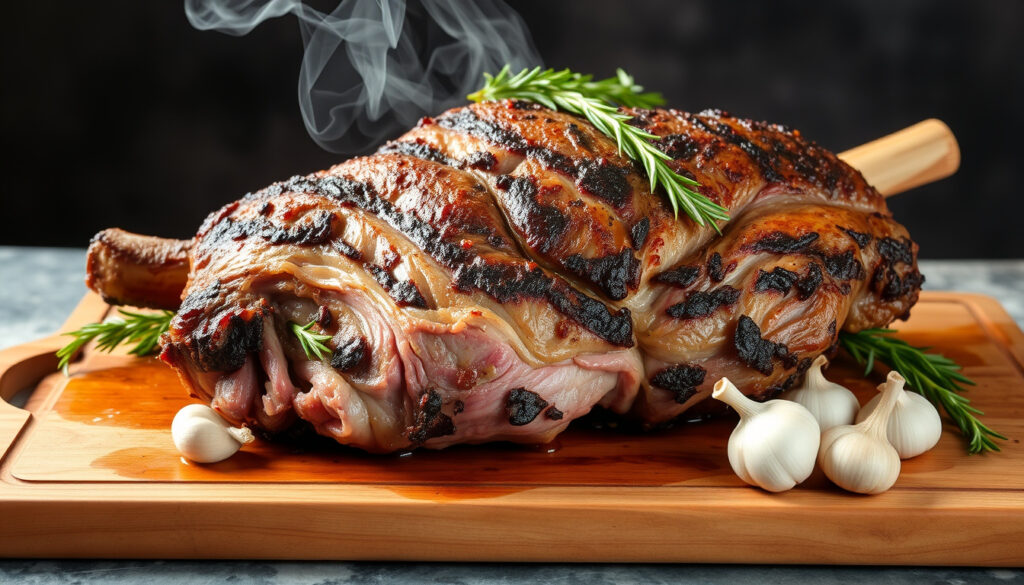
Slow Cooked Lamb Shoulder: Time, Temp & Mistakes
There’s a reason lamb shoulder is the cut that gets passed around the dinner table untouched until everyone’s plate is already full—it takes time, but the payoff is real. This guide cuts through the debate between oven and slow cooker, giving you the science-backed times, temperatures, and common pitfalls so your next lamb shoulder turns out exactly how you want it: tender, flavorful, and worth the wait.
Typical low slow-cook time (slow cooker): 8–12 hours on low · Typical oven slow-roast time (300°F/150°C): 4–5 hours (covered) · Internal temp for pull-apart tenderness: 195–205°F (90–96°C) · Rest time before serving: 20 minutes (tented with foil)
Quick snapshot
- Collagen breaks down at 160°F, turning tough connective tissue into gelatin – key for fall-apart texture (RecipeTin Eats (trusted recipe blog))
- Lamb shoulder must reach 145°F internal for food safety before resting (RecipeTin Eats (trusted recipe blog))
- Searing before cooking creates deep flavor via Maillard reaction (Chef Not Required (home cooking site))
- Exact maximum time before lamb shoulder dries out at low temp – varies by cut size and fat content (Reddit r/AskCulinary (community discussion))
- Whether 4 hours on high equals 8 hours on low in tenderness for lamb (general slow cooker rule exists, lamb-specific data is missing) (Reddit r/AskCulinary (community discussion))
- 0–30 min: bring lamb to room temp, sear all sides
- 4–8 hours (slow cooker low) or 4–5 hours (oven at 300°F): covered cooking until internal temp hits 195°F+
- Last 30 min: uncover for browning (oven method)
- After cooking: rest 20 minutes tented with foil
- Choose your method: slow cooker for set-and-forget, oven for crispy crust
- Check internal temp with a probe thermometer
- Shred and serve with pan juices or gravy
| Fact | Value |
|---|---|
| Optimal slow-cook temp | 195–205°F (90–96°C) |
| Standard cook time (oven) | 4–5 hours (covered at 300°F) |
| Standard cook time (slow cooker) | 8–12 hours on low |
| Collagen breakdown starts at | 160°F (71°C) |
| Common mistake #1 | Skipping the sear |
How long to slow cook lamb shoulder?
Timing is the number-one question home cooks ask, and the answer depends on your appliance and target temperature. Here’s what the recipes actually say.
Slow cooker timing (low vs. high)
For a 3–4 pound lamb shoulder, the consensus among home cooks is clear:
- Low setting (8–12 hours): Simple Home Edit recommends 10–12 hours on low until the meat is tender and falling off the bone (Simple Home Edit (home cooking site)). Chef Not Required says 10 hours on low (Chef Not Required (home cooking site)). Plays Well With Butter suggests 6–8 hours on low (Plays Well With Butter (recipe blog)).
- High setting (4–6 hours): Not recommended for best texture. A Reddit discussion notes that extending a 3-hour high cook to 6–8 hours on low gives a softer result (Reddit r/slowcooking (community discussion)).
Low heat gives collagen time to dissolve gradually. High heat forces the meat to contract before the connective tissue can break down, yielding tougher, drier meat.
Oven roasting timing (covered vs. uncovered)
Oven methods vary more. RecipeTin Eats has two popular approaches:
- Standard roast (180°C/350°F): 3 hours covered, then a final uncovered stage (RecipeTin Eats (trusted recipe blog)).
- Ultra-low method (100°C/210°F): 12 hours for maximum tenderness (RecipeTin Eats (trusted recipe blog)).
- Moderate slow-roast (150–160°C/300–320°F): Daen’s Kitchen recommends keeping it covered the whole time (Daen’s Kitchen (home cooking site)).
- American Lamb (industry source) uses 325°F oven with a Dutch oven start on the stovetop (American Lamb (industry association)).
The pattern: lower temperature means longer time but a bigger safety margin against drying out. Cooked & Loved gives a rule of thumb of 50–60 minutes per pound at 180°C/356°F (Cooked & Loved (home cooking site)).
Is lamb shoulder better in slow cooker or oven?
Three key differences, one bottom line: each method has a clear strength.
The choice between slow cooker and oven for lamb shoulder comes down to texture, convenience, and crust. Here’s a side-by-side look at three critical factors:
| Factor | Slow Cooker | Oven |
|---|---|---|
| Texture & tenderness | Very tender, almost shreddable after 8+ hours on low (Simple Home Edit (home cooking site)) | Fall-apart with a crust; can be drier if uncovered too long |
| Browning & crust | None – requires post-cook broil or sear (Slow Cooker Club (slow cooker site)) | Natural browning in final 30 minutes uncovered |
| Hands-off time | Set and forget – no lid lifting needed (Plays Well With Butter (recipe blog)) | Need to monitor temperature and uncover at end |
When each method wins
Choose the slow cooker when you want maximum convenience and a very moist result. Choose the oven when you want a crispy exterior and deeper flavor from dry heat. The Irishman’s Wife starts at 220°C/425°F then reduces to a covered roast – a hybrid approach (The Irishman’s Wife (home cooking site)). Slow Cooker Club even finishes a slow-cooked shoulder in the oven for 20 minutes at 190°C to get the best of both (Slow Cooker Club (slow cooker site)).
The trade-off: The slow cooker delivers foolproof tenderness with zero active time, but sacrifices crust. The oven gives a more complex flavor profile at the cost of a few extra minutes of attention.
What are common mistakes in slow cooking lamb shoulder?
Based on patterns across recipes and online discussions, here are five mistakes home cooks frequently make – and how to avoid each.
Mistake 1: skipping the sear
Searing creates the Maillard reaction – browning that adds layers of savory depth. Chef Not Required sears the shoulder in a hot pan before transferring to the slow cooker (Chef Not Required (home cooking site)). Without it, the final dish can taste flat.
Mistake 2: cooking on high instead of low
High heat tightens muscle fibers before collagen fully breaks down. Multiple sources agree: low and slow is the only way for fall-apart texture. Redditors recommend extending high-cook attempts to 6–8 hours on low (Reddit r/slowcooking (community discussion)).
Mistake 3: not adding enough liquid
At least ½ cup of stock, broth, or wine is essential to prevent burning. Chef Not Required places stock around the lamb rather than pouring it over, preserving the seasoning (Chef Not Required (home cooking site)). Daen’s Kitchen emphasizes covering to hold moisture (Daen’s Kitchen (home cooking site)).
Mistake 4: lifting the lid repeatedly
Each lid lift releases heat and steam, adding about 20 minutes to cooking time. Plays Well With Butter notes that slow cookers work best when left sealed (Plays Well With Butter (recipe blog)).
Mistake 5: undercooking to safe temp but not tenderness
Collagen begins dissolving at 160°F, but true tenderness requires 195–205°F internal. RecipeTin Eats’ 12-hour method proves that temperature matters more than time – the meat should pull apart easily with a fork (RecipeTin Eats (trusted recipe blog)).
Even with all the right moves, lamb shoulder can still dry out if cooked beyond 12 hours at low temp. The optimal window is 8–10 hours in a slow cooker, 4–5 hours in the oven at 300°F.
Does lamb shoulder get more tender the longer you cook it?
Yes – up to a point. Understanding the science helps you hit the perfect window.
Collagen-to-gelatin science
Lamb shoulder is rich in connective tissue. When heated slowly, collagen converts to gelatin, which makes the meat moist and tender. This process starts at 160°F and accelerates above 180°F. RecipeTin Eats explains that the long, low cook allows this to happen gradually (RecipeTin Eats (trusted recipe blog)).
The optimal window: 6 to 12 hours
Once collagen is fully converted (around 12 hours at low temp), further cooking only evaporates moisture and tightens muscle fibers. The sweet spot for slow cooker is 8–10 hours on low; for the oven at 300°F, 4–5 hours covered. Cooked & Loved’s per-pound rule aligns with this (Cooked & Loved (home cooking site)).
Why this matters: Cooking beyond 12 hours doesn’t improve tenderness – it starts to dry the meat out. Use a probe thermometer and stop when the internal temp reads 195–205°F.
How to cook lamb shoulder so it falls off the bone?
Falling-off-the-bone lamb is the gold standard. Here’s the step-by-step method that works for both slow cooker and oven.
Step-by-step: sear, braise, rest
- Sear all sides: Heat oil in a skillet and brown the lamb for 2–3 minutes per side. Chef Not Required says this layer of flavor is non-negotiable (Chef Not Required (home cooking site)).
- Add aromatics and liquid: Garlic, rosemary, and ½ to 1 cup of stock or wine. American Lamb uses a Dutch oven with a stovetop start (American Lamb (industry association)).
- Cook covered until internal temp reaches 195°F minimum. For oven, cover tightly with foil or a lid. RecipeTin Eats’ standard method is 3 hours at 350°F (RecipeTin Eats (trusted recipe blog)). For slow cooker, 8–10 hours on low.
- Uncover for browning (oven only): Last 30 minutes at the same temperature or slightly higher to develop crust.
- Rest 20 minutes tented with foil. Meat reabsorbs juices and reaches final pull-apart texture.
Temperature endpoint: 195–205°F
A digital thermometer is the only reliable way to judge doneness. The meat should shred easily under a fork. Simple Home Edit describes the visual cue as “tender and falling off the bone” (Simple Home Edit (home cooking site)).
Without a thermometer, you risk either undercooked (chewy) or overcooked (dry) meat. The 195–205°F sweet spot ensures collagen is fully converted without losing moisture.
Timeline for slow cooked lamb shoulder
| Time | Action |
|---|---|
| 0 min | Remove lamb from fridge, bring to room temp (30–45 min) |
| 30 min | Sear all sides in hot oil (5 min) |
| 35 min | Add aromatics and liquid, cover, place in oven/slow cooker |
| 4–5 hours (oven) / 8–10 hours (slow cooker) | Check internal temp – should be 195+°F |
| Cook time + 30 min | Uncover last 30 minutes for browning (oven method) |
| After cooking | Rest 20 minutes, tent with foil |
| After rest | Pull/shred and serve |
What we know and what’s still unclear
Confirmed facts
- Collagen breaks down at 160°F (RecipeTin Eats (trusted recipe blog))
- Searing improves flavor via Maillard reaction (Chef Not Required (home cooking site))
- For pull-apart texture, meat needs 195–205°F internal (Simple Home Edit (home cooking site))
What’s unclear
- Exact max time before meat dries out at low temp (varies by cut size and fat content)
- Whether 4 hours on high equals 8 hours on low in tenderness for lamb (Reddit r/AskCulinary (community discussion))
Expert perspectives on slow cooked lamb shoulder
“Lamb shoulder is one of the most forgiving cuts – as long as you cook it low and slow and bring the internal temperature up to at least 195°F, it will be tender.”
– Nagi Maehashi, RecipeTin Eats (RecipeTin Eats (trusted recipe blog))
“The secret to the most tender slow-cooked lamb is time. Give it 10 hours on low and you won’t need a knife.”
– Chef Not Required (Chef Not Required (home cooking site))
“Starting with a hot sear and finishing with a blast in the oven gives you both tenderness and a beautiful crust.”
– Slow Cooker Club (Slow Cooker Club (slow cooker site))
For home cooks aiming for fall-apart lamb shoulder, the choice is clear: use a slow cooker for hands-off tenderness or the oven for a crispier crust – but never skip the sear. Your thermometer is the real hero: pull the lamb at 195°F internal, rest it 20 minutes, and you’ll have a crowd-pleasing result every time.
Related reading: slow-roasted rosemary garlic lamb shoulder · slow-roasted lamb shoulder
Frequently asked questions
How do I know when lamb shoulder is done without a thermometer?
The meat should pull apart easily with a fork and appear moist, not pink. If it resists shredding, it needs more time. A thermometer is strongly recommended.
Can I cook lamb shoulder from frozen in a slow cooker?
No – always thaw completely first. Cooking from frozen can keep the meat in the bacteria danger zone for too long and lead to uneven cooking.
Should I trim the fat cap on lamb shoulder before slow cooking?
Leave some fat for moisture and flavor. Trim only large, hard pieces. The fat renders during cooking and keeps the meat tender.
What liquid is best for slow cooking lamb shoulder?
Beef or chicken stock, red wine, or a combination. Avoid water alone – it dilutes flavor. Use about ½ to 1 cup; enough to cover the bottom of the pot.
How do I thicken the gravy from slow cooked lamb shoulder?
After cooking, remove the meat and strain the liquid. Simmer on the stovetop with a cornstarch slurry (1 tbsp cornstarch + 2 tbsp cold water) until thickened, or reduce by half.
Can I cook lamb shoulder on high in a slow cooker?
You can, but the texture will be less tender. Low heat breaks down collagen slowly; high heat tightens muscle fibers. For best results, always use low.
How do I reheat leftover slow cooked lamb shoulder without drying it out?
Place in a covered dish with a splash of broth and reheat in a 300°F oven for 15–20 minutes, or microwave in short bursts with a damp paper towel. Avoid high heat.
More related posts
 Mitre 10 Te Anau: Hours, Products & 10km Event
 Palmerston North to Auckland Flights: Price, Time & Train vs Air
 San Michelle Bags NZ: Prices, Reviews & Warranty
 Nike Pegasus Trail 5 Review: Specs, GTX, Comfort
 NZD to VND Exchange Rate: Compare Best Banks & Transfer Services
 Double Sided Tape NZ: Strongest at Kmart, Bunnings, Mitre 10
 Sarah J. Maas Books in Order: Complete Reading Guide (2025)
 Julia Louis-Dreyfus – Biography, Emmys, Family, Net Worth