Signs of Bowel Cancer: Early Warning Signs & Symptoms
The symptoms of bowel cancer are often subtle, but they rarely appear without warning. A change in your bowel habits that lasts more than three weeks, blood in your stool, or persistent fatigue are the kind of signs that deserve your attention — not your patience.
4th most common cancer globally: over 1.9 million new cases per year (Globocan 2020) ·
90% survival with early detection: 5‑year relative survival of 90% for localized colorectal cancer (American Cancer Society) ·
1 in 20 risk over a lifetime: about 4–5% of people will develop colorectal cancer (NCI) ·
Most diagnosed after age 50: median age at diagnosis is 66 (NCI SEER)
Quick snapshot
- Exact pain location varies by tumour position and individual anatomy
- Whether early‑stage symptoms differ between men and women is not fully categorized
- The role of diet and exercise in prevention remains under study
- Stage 1 bowel cancer: 90% survive 5 years (Cancer Research UK)
- Stage 4 bowel cancer: ~10% survive 5 years (Cancer Research UK)
- Book a GP appointment if you have any persistent symptom (NHS)
- Take the NHS FIT home test when invited from age 60 (50 in Scotland) (NHS)
Five key facts, one pattern: survival drops drastically as the cancer advances — the sooner you act, the better your odds.
The table below maps the critical numbers every adult should know.
| Fact | Value | Source |
|---|---|---|
| Most common first sign | Blood in stool or change in bowel habits | NHS |
| Average age at diagnosis | 66 years | NCI SEER |
| 5‑year survival (localized) | 90% | American Cancer Society |
| 5‑year survival (advanced) | 14% | Cancer Research UK |
| Lifetime risk (US) | 4.2% for men, 3.9% for women | NCI |
The implication: the gap between 90% and 14% is almost entirely about timing — and that timing is in your hands.
What are the early warning signs of bowel cancer?
Changes in bowel habits
- Needing to poo more or less often than usual (NHS)
- Feeling an ongoing urge to poo even after going to the toilet (NHS)
- Stools that are narrow or ribbon‑like
A change in bowel habits lasting more than three weeks is a key sign, according to the NHS. Many people dismiss this as diet or stress, but if the pattern persists, it’s worth a conversation with your GP.
A subtle shift in frequency or consistency is one of the earliest signals that a tumour may be affecting the bowel lining. Catching it at this stage gives you a 90% shot at five‑year survival.
Blood in your stool
- Bright red or dark blood in poo (NHS)
- Bleeding from the bottom without a known cause (Mayo Clinic)
- Black or dark red poo — seek urgent medical help
Blood in the stool is one of the most common early signs, notes the Mayo Clinic. The NHS advises an urgent GP appointment or NHS 111 if your poo is black or dark red, or if you have bloody diarrhoea.
The implication: any visible blood — even a one‑off — should not be dismissed as piles. Bleeding from a tumour is often intermittent, but every episode is a signal.
Unexplained weight loss
- Losing weight without trying (Cancer Research UK)
- Often occurs even without other symptoms
Unexplained weight loss can occur even when other symptoms are absent, according to Cancer Research UK. This happens because the tumour consumes energy and may cause the body to break down fat and muscle.
Feeling tired or weak
- Persistent tiredness that doesn’t improve with rest
- Shortness of breath — may indicate anaemia (NHS)
Bowel cancer can cause anaemia from chronic blood loss, which presents as tiredness or shortness of breath, says the NHS. The Royal Marsden notes that iron deficiency anaemia is often the first clue in people over 50.
What is the biggest red flag for bowel cancer?
Rectal bleeding as the primary red flag
- Bright red or dark blood in stool is the most common red flag (NHS)
- Bleeding from the bottom without a known cause requires prompt medical evaluation (Mayo Clinic)
According to Mayo Clinic colorectal surgeons, blood in the stool should never be ignored — even if it’s small. The NHS emphasises that if your poo is black or dark red, it’s an emergency.
Many people assume rectal bleeding is haemorrhoids, but bowel cancer bleeding can look identical. Without a colonoscopy, there’s no way to tell the difference — that’s why any bleeding deserves a doctor’s look.
When to seek emergency care
- Heavy bleeding from the bottom
- Signs of anaemia: dizziness, shortness of breath, pale skin
- Sudden change in stool shape (narrow stools)
Heavy bleeding or symptoms of anaemia — like dizziness and shortness of breath — are emergencies, advises Cancer Research UK. A sudden change to narrow or ribbon‑like stools can signal a tumour that is partially blocking the bowel.
What are the symptoms of Stage 1 bowel cancer?
Why Stage 1 symptoms are often missed
- Stage 1 bowel cancer may cause no symptoms at all (NCI)
- When present, symptoms are subtle: small change in bowel habits or trace blood (American Cancer Society)
- Screening is the most reliable way to detect Stage 1 cancer (USPSTF)
According to the National Cancer Institute, Stage 1 bowel cancer often has no symptoms. When it does, the American Cancer Society notes they include subtle changes in bowel habits or trace amounts of blood that may only be visible under a microscope.
What this means: you cannot rely on symptoms alone to catch bowel cancer early. The USPSTF recommends routine screening from age 45–50 precisely because early cancer is silent.
Common early symptoms
- Slight change in how often you poo
- Feeling like you haven’t fully emptied your bowels
- Bright red blood on toilet paper (may be mistaken for piles)
When Stage 1 does produce symptoms, they are easily dismissed. The Cancer Research UK data shows that one‑year survival for screening‑detected bowel cancer is 97%, compared to 49% after emergency presentation — a gap larger than for almost any other common cancer.
Where is bowel cancer pain felt?
Abdominal pain location
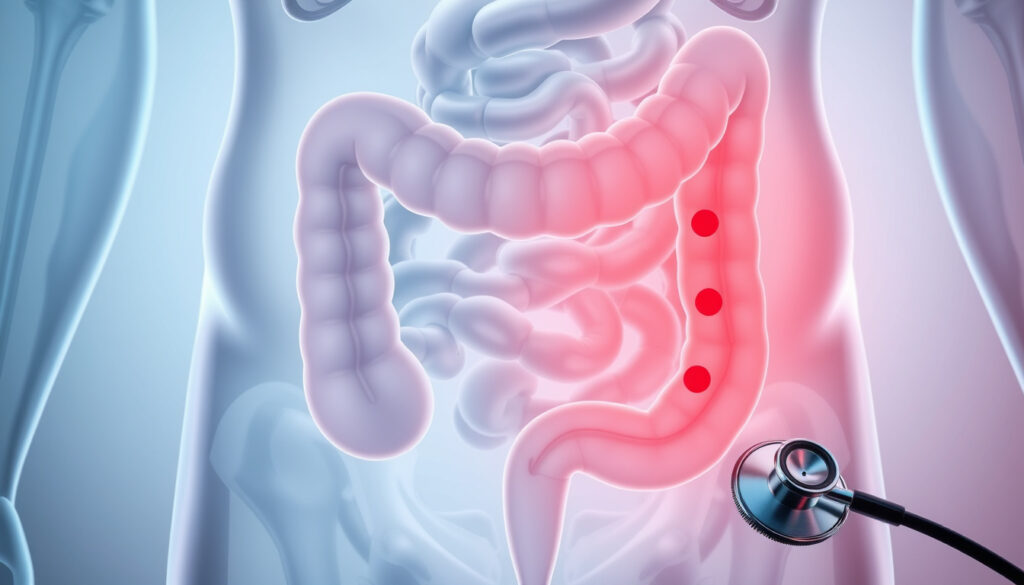
- Pain is often felt in the lower abdomen (NHS)
- Left‑sided colon cancers may cause cramping or blockage pain (Mayo Clinic)
- Right‑sided cancers often cause a dull ache rather than sharp pain
The NHS reports that pain is most common in the lower abdomen. Mayo Clinic specialists note that left‑sided tumours can cause cramping and a sensation of partial blockage, while right‑sided tumours often produce a vague, dull ache.
Pain in the lower back
- Back pain can occur when the tumour presses on nearby nerves (Cancer Research UK)
- Often described as a persistent, nagging ache that doesn’t change with movement
According to Cancer Research UK, back pain from bowel cancer is typically caused by nerve compression from a tumour that has grown through the bowel wall. It’s less common than abdominal pain but is a red flag when it appears alongside other symptoms.
Pain during bowel movements
- Tenesmus — a feeling of needing to poo even when the bowel is empty (Royal Marsden)
- Pain or discomfort while passing stool
The Royal Marsden describes tenesmus as a possible symptom of bowel cancer, especially for rectal tumours. This constant urge to go, even after a bowel movement, is both uncomfortable and distressing.
Pain location depends on where the tumour sits. Left‑sided cancers tend to cause cramping and obstruction; right‑sided cancers cause a dull ache. Back pain is a later sign that suggests nerve involvement.
What age is common for bowel cancer?
Over 50: the highest risk group
- 90% of cases occur in people aged 50 or older (American Cancer Society)
- Median age at diagnosis is 66 (NCI SEER)
- Risk increases with each decade after 50
The American Cancer Society states that nine out of ten bowel cancer cases are diagnosed in people 50 or older. The NCI SEER database puts the median diagnosis age at 66. For those over 50, screening is the single most effective preventive tool.
Younger adults and hereditary factors
- Younger adults with Lynch syndrome or family history are at higher risk (American Cancer Society)
- Rising incidence in under‑50s is being studied
- Screening may begin earlier if strong family history
While bowel cancer is far less common in younger people, those with a family history — especially conditions like Lynch syndrome — face elevated risk, notes the American Cancer Society. Recent studies show a gradual rise in early‑onset cases, which has led some countries to lower the screening age to 45.
Actionable steps: what to do if you notice signs
- Check your symptoms against the NHS list: blood in poo, change in bowel habits lasting 3+ weeks, unexplained weight loss, persistent tiredness, abdominal pain or bloating.
- Book a GP appointment urgently if you have any of these signs. The NHS advises calling NHS 111 if your poo is black or dark red, or if you have bloody diarrhoea.
- Take the screening test when invited. In England, the NHS sends a FIT (Faecal Immunochemical Test) every two years to people aged 60–74 (from age 50 in Scotland). The National Screening Blog reports that screening found 5,320 bowel cancers in a recent data set, with a detection rate of 0.11%.
- Prepare for your appointment — write down your symptoms, when they started, and any family history of bowel cancer.
- Follow up if symptoms continue after a normal test result. No test is perfect, and persistent symptoms warrant further investigation.
Confirmed facts and what’s unclear
Confirmed facts
- Blood in stool is a well‑established sign of bowel cancer (multiple RCTs, NHS)
- Change in bowel habits persisting >3 weeks is a validated warning signal (NHS)
- Screening reduces mortality by 30–50% (large cohort studies, GOV.UK)
- 5‑year survival for stage 1 is 90%, for stage 4 it is ~10% (Cancer Research UK)
What’s unclear
- Exact location of pain varies by individual anatomy and tumour position
- Whether early‑stage symptoms differ between men and women is not fully categorized
- The role of diet and exercise in prevention remains under study
- The exact rate at which adenomatous polyps become cancerous is not precisely known
Expert perspectives
“Screening is one of the most powerful tools we have to prevent colorectal cancer or catch it early when treatment is most effective. We urge everyone to talk to their doctor about when to start screening.”
— Dr. Lisa Richardson, CDC Division of Cancer Prevention and Control
“Nine out of ten bowel cancers are treatable if caught early. That’s why we are investing in expanding the screening programme and raising awareness of the key symptoms.”
— NHS bowel cancer screening programme spokesperson
“Blood in the stool is the most common red flag, yet so many patients dismiss it as piles. If you see blood, don’t wait — see your doctor that week.”
— Mayo Clinic colorectal surgeon
The evidence is clear: the earlier bowel cancer is caught, the more survivable it becomes. The GOV.UK data shows that 1‑year survival with screening‑detected cancer is 97%, versus 49% after an emergency admission. That is a 48‑point gap, driven almost entirely by timing.
For anyone over 50, the implication is straightforward: do not wait for symptoms to become severe. A routine FIT test or colonoscopy while you feel well is far better than an emergency diagnosis. For younger readers with a family history, the same rule applies — start the conversation with your GP now.
bowelcanceruk.org.uk, essex.icb.nhs.uk, cancer.org.au, cancerresearchuk.org, coloncancercoalition.org, shropshiretelfordandwrekin.nhs.uk, pmc.ncbi.nlm.nih.gov, bswhealth.com
While many people hesitate to seek help, understanding bowel cancers early warning signs can dramatically improve survival rates by prompting earlier medical attention.
Frequently asked questions
What does bowel cancer look like in stool?
Bowel cancer may cause blood that is bright red, dark red, or black. Stools may become narrow or ribbon‑like. A FIT test can detect hidden blood that isn’t visible to the naked eye.
Can bowel cancer cause back pain?
Yes, back pain can occur when a tumour presses on nearby nerves, especially in advanced stages. It is less common than abdominal pain but should not be ignored.
Is bowel cancer painful?
Early‑stage bowel cancer often causes no pain. As it grows, it can cause abdominal cramping, discomfort, or pain, often in the lower abdomen or left side.
How long can you have bowel cancer without knowing?
Bowel cancer can grow for months or even years before causing noticeable symptoms. That’s why regular screening starting at age 45–50 is so important.
What are the first signs of bowel cancer in men?
The first signs in men are the same as in women: blood in stool, change in bowel habits, abdominal pain, unexplained weight loss, and fatigue. Men are slightly more likely to develop colorectal cancer than women.
What are the first signs of bowel cancer in women?
Women may also experience anaemia‑related fatigue and shortness of breath as early signs. The symptom profile is broadly similar, though some studies suggest women may present with more right‑sided tumours, which cause a dull ache rather than sharp pain.
What is the survival rate of bowel cancer?
Five‑year survival ranges from 90% for stage 1 to around 10% for stage 4. Overall, about 60% of people in England survive 5 years or more (Cancer Research UK).
How is bowel cancer diagnosed?
Diagnosis typically begins with a FIT test, followed by a colonoscopy if blood is detected. If cancer is found, a biopsy and imaging scans (CT, MRI) are used to determine the stage.
More related posts
 Pukekohe Pak’nSave: Owner, Prices, History and More
 Cast of The Big C: Characters, Cancer & Where to Watch
 Coronation Street Spoilers Next Week: Drama & Exits
 Businesses for Sale in Auckland: Listings & Buying Guide
 2026 Winter Olympics Snowboarding: Schedule, Venue, Lineup & Results
 Ginny and Georgia Season 3: Release Date, Cast, Plot & News
 Good Morning in Māori: Mōrena vs Ata Mārie
 Best Cooling Fan 2026: Pedestal vs Tower vs Bladeless