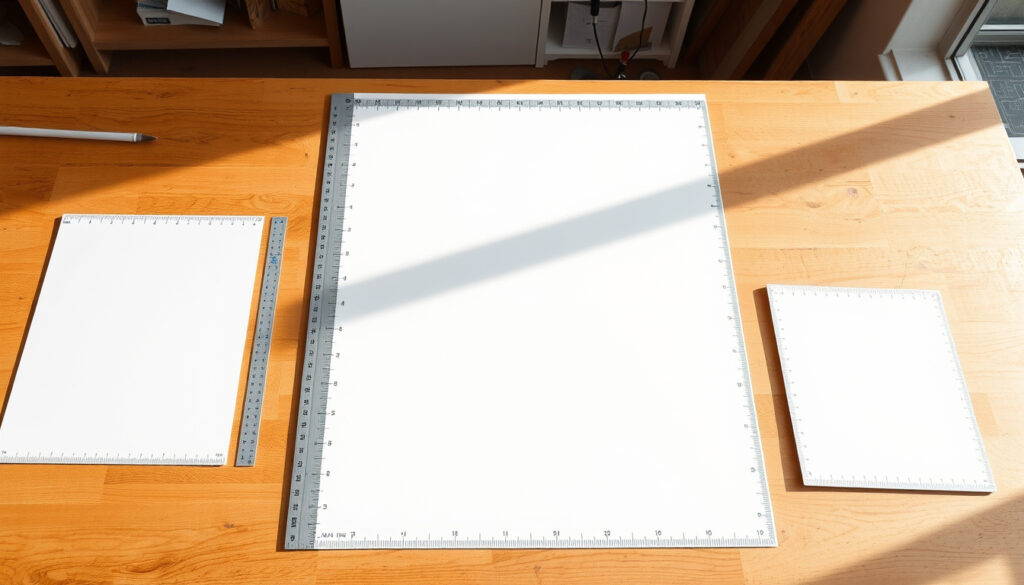
How Big is A1 Paper? Dimensions in mm, cm, Inches & Comparisons
If you’ve ever stood in a print shop wondering why a poster labeled “A1” looks so much larger than the paper in your home printer, you’re not alone. The A-series paper sizes follow a precise international standard that can feel opaque until someone explains the logic behind it. This guide lays out exactly how big an A1 is, how it compares to other sizes, and why the system works the way it does.
A1 Dimensions (mm): 594 × 841 · A1 Dimensions (inches): 23.4 × 33.1 · A1 Dimensions (cm): 59.4 × 84.1 · A2 Dimensions (mm): 420 × 594 · A4 Dimensions (mm): 210 × 297
Quick snapshot
- 594 × 841 mm (Phomemo)
- 59.4 × 84.1 cm (Canva)
- 23.4 × 33.1 inches (Papersizes.org)
- Pixel dimensions at 300 DPI vary slightly by software rounding conventions (Papersizes.io)
- ISO 216 standard established 1975; A4 became globally dominant in the 1990s (Wikipedia)
- North America remains the primary region not using ISO 216; Letter-size paper persists there
| Specification | Value |
|---|---|
| Standard Size (mm) | 594 × 841 |
| Inches | 23.4 × 33.1 |
| Cm | 59.4 × 84.1 |
| Series Position | Between A0 and A2 |
| Typical Use | Posters and plans |
How big is an A1 size poster?
A1 in mm, cm, and inches
An A1 poster measures 594 mm × 841 mm, which translates to 59.4 cm × 84.1 cm. In imperial units, the standard measurement is 23.4 × 33.1 inches, though some references quote 23-3/8 × 33-1/8 when rounded to the nearest fractional inch (Neenah Paper). The slight variation stems from rounding conventions when converting from millimeters: 594 mm is 23.386 inches, rounded to 23.4 in decimal form.
The surface area of an A1 sheet is exactly 0.5 square meters — a direct consequence of the ISO 216 system where A0, the base size, covers one square meter. Production tolerances are specified at ±2 mm for dimensions in the 150–600 mm range, tightening to ±3 mm for larger measurements (Papersizes.org).
Real-world comparisons
To visualize an A1 poster, picture four A4 sheets arranged in a 2 × 2 grid — that is precisely the area a single A1 covers. In the printing industry, this size is the go-to choice for large-format posters, architectural drawings, and engineering plans where legibility from a distance matters.
- Approximately the footprint of a small desk surface
- Twice the height of a standard US Letter page placed upright
- Fits comfortably in most standard poster frames sold in office supply stores
An A1 poster is large enough to command attention from across a room while remaining manageable enough for wall mounting without professional assistance — a practical sweet spot that explains its dominance in advertising and technical documentation alike.
Is A1 or A2 bigger?
A1 vs A2 dimensions
A1 is the larger of the two. An A1 measures 594 × 841 mm, while an A2 comes in at 420 × 594 mm. In inches, A2 is 16.54 × 23.39. This means A1 is not merely slightly bigger — it has exactly double the surface area of A2.
Visual size difference
The relationship between A-series sizes follows a halving rule: cutting an A0 sheet in half parallel to its shorter side yields two A1 sheets. Cutting an A1 in half the same way produces two A2 sheets, and so on down the series. Every step halves the area while preserving a 1:√2 aspect ratio, so the shapes remain proportional regardless of size.
Papersizes.org The A series paper sizes are defined in ISO 216 by the following requirements: The length divided by the width is 1.4142, and the A0 size has an area of 1 square metre.
What this means practically: an architect’s A1 landscape plan folds out to show exactly twice as much area as an A2 drawing. In office contexts, A1 flip chart pads are uncommon precisely because the size becomes unwieldy for individual presentation — A2 or A3 serves that purpose better.
Because the aspect ratio stays constant (1:√2, or approximately 1.4142), any A-series page can be photocopied or scaled to any other A-series size without distortion — a property unique to this paper system and one that makes print production far more efficient.
What does A1 size look like?
Everyday object comparisons
A1 paper is large enough that most people have encountered it without realizing what they were looking at. Standard large-format posters at transit stations, convention banners, and engineering blueprints are typically A1 or close to it.
- Two standard US Letter pages placed side by side come close to A1 width
- Approximately the size of a single door on a residential interior door
- Slightly taller than a basketball backboard is wide
Common uses
The A1 size fills a specific niche in printing: large enough for professional display work, yet standardized enough that off-the-shelf frames and portfolio cases are widely available. Architectural firms use A1 for presentation drawings. Advertising agencies specify A1 for retail point-of-sale materials. Engineering teams rely on it for technical schematics that need to be pinned to a drafting table or unrolled during site visits.
At 23.4 inches wide, an A1 poster can be oriented either portrait (594 mm tall) or landscape (841 mm tall), making it versatile for different content layouts — though portrait dominates for poster and signage applications.
How big is A1 in cm, inches, and feet?
Metric and imperial sizes
Beyond the core measurements, understanding A1 in feet can help when working with room dimensions or display planning. Converting 594 mm × 841 mm to feet gives approximately 1.95 × 2.76 feet — numbers that rarely appear on packaging but prove useful when estimating wall space for poster installations.
Across all metric representations, sources converge tightly: 59.4 × 84.1 cm (Canva), 594 × 841 mm (Phomemo), and 23.4 × 33.1 inches (Papersizes.org). The University of Melbourne Print Room confirms this consistency across institutional and industry sources alike.
A1 area
With a surface area of 0.5 square meters, an A1 sheet occupies roughly 5.38 square feet. For context, that is about the size of a standard kitchen countertop in a small apartment — a useful mental benchmark when planning where a printed A1 piece might hang.
How many A4 in A1?
A-series halving rule
Exactly four A4 sheets fit inside one A1. This is not a coincidence — it follows directly from the halving rule that governs the entire A-series. Because A4 measures 210 × 297 mm, two A4 sheets placed side by side (width to width) give 420 mm, which matches A2’s shorter dimension. Two rows of two A4 sheets stacked vertically produce the full 594 mm width of A1. A4 is the international letterhead standard at 210 × 297 mm and remains the most widely used A-series size globally.
When laying out an A1 design in desktop publishing software, placing four A4 pages side by side leaves roughly 2 mm margins between them — a consequence of the mathematical rounding built into the ISO standard. Printers designed for A1 typically handle this automatically.
Full A0 to A6 overview
The A-series runs from A0 (the base size at 841 × 1189 mm, covering exactly 1 m²) down to A10. Each step halves the previous size. The table below shows how the dimensions progress across the most commonly referenced sizes.
| Size | Dimensions (mm) | Dimensions (inches) | Area relative to A1 |
|---|---|---|---|
| A0 | 841 × 1189 | 33.1 × 46.8 | 2× A1 |
| A1 | 594 × 841 | 23.4 × 33.1 | Baseline |
| A2 | 420 × 594 | 16.5 × 23.4 | ½× A1 |
| A3 | 297 × 420 | 11.7 × 16.5 | ¼× A1 |
| A4 | 210 × 297 | 8.27 × 11.7 | ⅛× A1 |
| A5 | 148 × 210 | 5.83 × 8.27 | 1/16× A1 |
| A6 | 105 × 148 | 4.13 × 5.83 | 1/32× A1 |
The pattern is consistent: each size halves the previous one. A2 is half A1, A3 is half A2, and so on. This elegant mathematical property means that a photograph or design scaled between any two A-series sizes retains perfect proportions — an advantage that makes the ISO 216 system indispensable for global printing operations. For a comprehensive understanding of A1 paper sizes, consult this informative guide: The Warehouse Auckland Airport
Adobe Creative Cloud A1 represents ½ of an A0 sheet and measures 59.4 × 84.1 cm.
The practical implication is that a designer can create a single layout file and confidently scale it across any A-series size without recalculating margins or adjusting the composition. A document that looks right on A4 will look equally right on A1, A3, or A0.
How does the A-series work?
The A-series belongs to the ISO 216 standard, which has been the global paper size standard since its establishment, with near-universal adoption outside North America. Every size in the series derives its dimensions from two rules: the aspect ratio is fixed at 1:√2 (approximately 1.4142), and A0 has an area of exactly 1 square meter.
From those two constraints, all other sizes follow mathematically. Cutting A0 in half parallel to its shorter side produces two A1 sheets. Cutting A1 in half produces two A2 sheets, and so on. The aspect ratio ensures that when you fold any sheet in half across its shorter side, the resulting piece maintains the same proportions — which is why the system scales so cleanly.
The tolerance specifications built into ISO 216 reflect manufacturing realities: ±2 mm for dimensions between 150 and 600 mm, and ±3 mm for dimensions over 600 mm. These tolerances are narrow enough to ensure interchangeability but realistic enough for paper mills operating at scale.
North America stands apart from this system. The United States and Canada use Letter and Ledger/Tabloid sizes instead, which follow no consistent aspect ratio and are not interchangeable with ISO 216. This is why international print projects often require careful attention to paper size specifications — a file set up for Letter will not fit an A4 envelope without adjustment.
For anyone producing or ordering printed materials internationally, the A-series is a baseline professional requirement. A designer who knows that A1 equals four A4 pages can immediately calculate how many sheets a print run will yield from a parent A0 sheet, or how to split an A1 design across smaller formats for proofing.
Related reading: What Does Shingles Look Like? Pictures & Early Signs · What Are Tonsil Stones – Causes, Symptoms, Safe Removal
ms-kb.msd.unimelb.edu.au, a2-size.com, elfai.lt, pacificwise.com.my, business.walmart.com
The ISO 216 standard defines A1 as 59.4 x 84.1 cm, with A1 cm dimensions chart providing a clear chart for series comparisons and practical uses.
Frequently asked questions
What size is A2?
A2 measures 420 × 594 mm (16.54 × 23.39 inches). It is exactly half the area of A1 — cutting an A1 sheet in half along its shorter side produces two A2 sheets.
What size is A4 in cm?
A4 is 21.0 × 29.7 cm. It is the international letterhead standard and the most widely used A-series size globally for office correspondence and documents.
Which size is bigger, A1, A2, A3, A4, and A5?
A1 is the largest among these, followed by A2, then A3, A4, and A5. Each step halving the area: A1 is double A2, A2 is double A3, and so on down the series.
What is A1, A2, A3, and A4?
They are sizes within the ISO 216 A-series, an international paper size standard. A0 is the base size (1 m²), and each subsequent size is derived by halving the previous one while maintaining a 1:√2 aspect ratio.
Is A4 the same as A1?
No. A4 is 210 × 297 mm, while A1 is 594 × 841 mm. Four A4 sheets equal one A1 sheet in area. They are not interchangeable.
What does A1 stand for?
In the ISO 216 system, the letter “A” denotes the series, and the number indicates how many halving steps from A0 the size is. A1 means one halving from A0 — the first step in the series.
How big is a1 printer?
A printer capable of handling A1 paper accepts sheets up to 594 × 841 mm. Large-format inkjet printers in the 24-inch wide format category typically handle A1/D-size printing as a standard capability.
How many A4 pages are in an A1?
Exactly four A4 pages fit inside a single A1 sheet. Two A4 pages placed side by side (width to width) and two rows of those equal the full A1 dimensions.
Print designers working across borders can specify A-series dimensions in every brief and template, verify printer capabilities before submitting files, and remember that four A4 pages always equal one A1 — a rule that holds regardless of which country the print shop calls home.
More related posts
 The Gentlemen Season 2 – Release Date, Cast and Plot Details
 How to Declutter Digital Files: A Step-by-Step Guide (2025)
 Bus Stop Near Me – Find & Track Dublin Cork Buses
 Tyler the Creator Tickets – 2025 Chromakopia Dates and Prices
 Weather Tomorrow Ireland: Met Éireann Dry 18-20°C Forecast
 NZ Dollar in India Today Rate: 1 NZD = 56.02 INR
 Nike Pegasus Trail 5 Review: Specs, GTX, Comfort