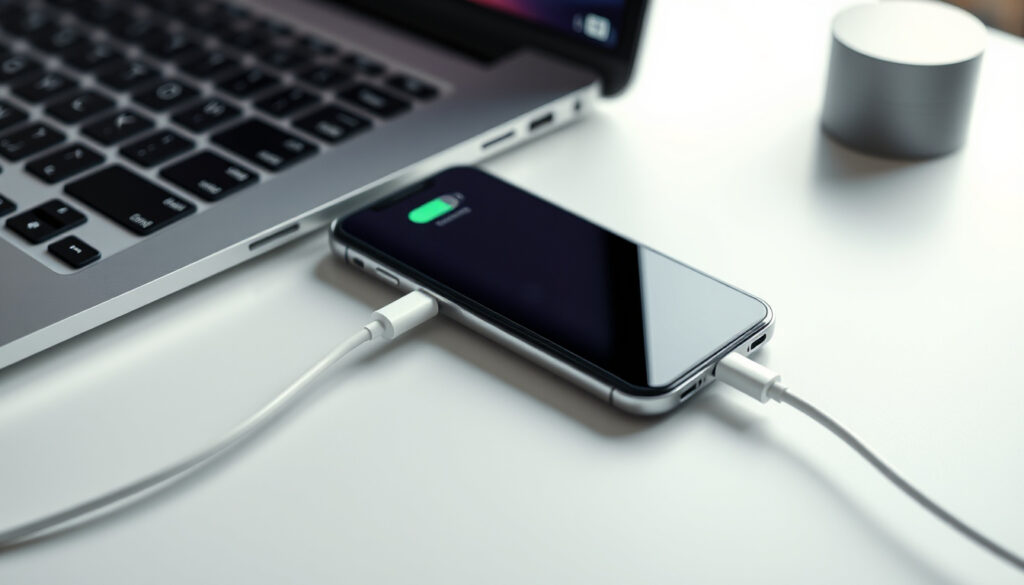
USB-C to Lightning Cable: Guide to Compatibility & Uses
Apple’s USB-C to Lightning cable lets you connect older Lightning iPhones and iPads to modern USB-C chargers and computers. With EU regulations now requiring USB-C on mobile devices, understanding these cables matters more than ever.
Standard Lengths: 1m, 2m · Compatible Devices: iPhone, iPad, iPod with Lightning · Connection Types: USB-C to Lightning · Charging Support: Syncing and charging · Official Retailers: Apple, Currys, Harvey Norman
Quick snapshot
- Apple sells USB-C to Lightning cables directly (Apple Ireland product page)
- Works with iPhone, iPad, and iPod devices featuring Lightning ports (Apple Ireland product page)
- Supports fast charging on compatible iPhone and iPad models (Apple Ireland product page)
- Exact timeline for complete Lightning phase-out across all Apple products
- Whether fast charging speeds remain consistent across third-party adapters
- EU USB-C mandate for phones took effect 28 December 2024 (European Commission official announcement)
- iPhone 15 launched with USB-C in September 2023 (Evelatus industry analysis)
- Laptops must comply with EU USB-C rules by 28 April 2026 (European Commission official announcement)
- New USB-C iPhone SE expected March 2025 (Slashdot technology news)
Key Facts
The spec sheet for USB-C to Lightning cables shows a product built for a transition period—Apple’s official hardware bridging legacy devices to modern infrastructure.
| Specification | Details |
|---|---|
| Primary Use | Charging and syncing Lightning devices |
| Connector A | USB-C |
| Connector B | Lightning |
| Lengths Available | 1m, 2m |
| Brands | Apple, Belkin |
| Fast Charging | Supported on select iPhone and iPad models |
| Data Transfer | Syncs with USB-C or Thunderbolt 3 Mac/PC |
| Compatible Adapters | Apple 18W, 20W, 29W, 30W, 61W, 87W, 96W USB-C Power Adapters |
The implication: these cables serve a shrinking market as Apple phases out Lightning across its entire device lineup.
Do USB-C to Lightning Cables Work?
Yes—USB-C to Lightning cables function exactly as designed. The Apple USB-C to Lightning Cable (1m) connects any iPhone, iPad, or iPod with a Lightning connector to USB-C or Thunderbolt 3 enabled devices (Apple Ireland). The cable works with Apple 18W, 20W, 29W, 30W, 61W, 87W, or 96W USB-C Power Adapters for charging purposes (Apple Ireland).
Compatibility with iPhone and iPad
The cable pairs older Lightning-equipped iPhones and iPads with newer USB-C power adapters. This matters because Apple shifted to USB-C on the iPhone 15, which launched in September 2023 (Evelatus). If you’re using an iPhone 14 or earlier model, a USB-C to Lightning cable lets you charge from the same USB-C adapters now common in homes and offices.
Charging and Syncing Functions
The cable supports fast-charging on selected iPhone and iPad models (Apple Ireland). For data transfer, it syncs your device to a USB-C or Thunderbolt 3 Mac, making it useful for moving photos, backups, and files.
Apple’s transition from Lightning to USB-C on iPhones is primarily driven by European Union regulations aimed at reducing e-waste (Evelatus). The USB-C to Lightning cable serves as a bridge for the millions of Lightning accessories and devices still in circulation.
What Is the Difference Between C to C and C to Lightning Cable?
Three key differences separate USB-C to USB-C cables from USB-C to Lightning cables: connector ends, device compatibility, and charging capabilities.
Connector Ends
USB-C to USB-C cables have the same connector type on both ends—both are reversible, oval-shaped USB-C ports. USB-C to Lightning cables have a USB-C connector on one end (for chargers and computers) and Apple’s proprietary Lightning connector on the other (for older iPhones, iPads, and iPods). USB-C has become the industry standard due to its faster charging and data transfer capabilities (Evelatus).
Device Compatibility
USB-C to USB-C works only with devices that have USB-C ports—newer Android phones, modern laptops, iPhone 15 and later, and current iPads. USB-C to Lightning is specifically for Apple devices that still use the Lightning port: iPhone 14 and earlier, older iPad models, and iPod devices. USB-C was already used in Apple’s MacBooks and iPad Pros before iPhone adoption (Evelatus).
USB-C offers faster data transfer speeds and potentially quicker charging compared to Lightning (Evelatus). If you’re using a Lightning device with a USB-C to Lightning cable, you’re capped by Lightning’s maximum speeds—even if your charger is USB-C.
Comparison: USB-C to Lightning vs USB-C to USB-C
The head-to-head comparison reveals why these cable types serve fundamentally different device generations.
| Feature | USB-C to Lightning | USB-C to USB-C |
|---|---|---|
| Connector A | USB-C | USB-C |
| Connector B | Lightning | USB-C |
| Primary Use | Connect Lightning devices to USB-C chargers/Mac | Connect USB-C devices to USB-C chargers/Mac |
| Device Range | iPhone 14 and earlier, older iPads, iPods | iPhone 15+, modern Android, laptops, newer iPads |
| Fast Charging | Supported on compatible models | Generally faster, wider compatibility |
| Data Transfer | Limited by Lightning speeds | Full USB-C/Thunderbolt speeds |
| Reversible | Lightning end not reversible | Both ends reversible |
The pattern: Lightning cables are backward-looking, USB-C cables are forward-looking.
Why Would I Need a USB-C to Lightning Cable?
You need a USB-C to Lightning cable when you have a Lightning-equipped device but a USB-C charger—or when you want to sync an older iPhone or iPad to a modern Mac that only has USB-C ports.
Transitioning to USB-C Chargers
As USB-C becomes the default, many households now have USB-C chargers from laptops, tablets, or newer phones. If your iPhone or iPad still uses Lightning, a USB-C to Lightning cable lets you use those existing chargers without buying new ones. The EU mandate that took effect 28 December 2024 requires USB-C on mobile phones, tablets, and other small electronics sold in the EU (European Commission). This regulatory push explains why USB-C chargers have proliferated.
Connecting to Modern Macs
Current MacBooks and many Windows laptops only have USB-C or Thunderbolt 3 ports. If you’re backing up an older iPhone or transferring files from an iPad with Lightning, you need a USB-C to Lightning cable to connect directly. USB-C has a reversible design making it as easy to plug in as Lightning cables (Evelatus).
Is Apple Phasing Out Lightning?
Yes—Apple is transitioning away from Lightning, driven primarily by EU regulations. The iPhone 15, launched in September 2023, was the first iPhone to use USB-C (Evelatus). Apple has already started pulling its iPhone SE and iPhone 14 models from sale in Switzerland ahead of the EU USB-C mandate taking effect 28 December 2024 (Slashdot).
iPhone 15 Changes
The iPhone 15 marked a significant shift—Apple’s first flagship iPhone with USB-C. This change cascaded through Apple’s ecosystem, with AirPods cases and accessories following suit. Lightning persists for older models and budget devices like the iPhone SE, but new releases now come USB-C native.
EU Regulations Impact
The EU is not requiring Apple to use USB-C specifically, but rather requiring the use of a USB standard to avoid permanent lock-in to a single connector (Slashdot). The USB-IF has a track record of developing and standardizing improved technologies as industry needs and capabilities change (Slashdot). A new USB-C compatible iPhone SE is expected in March 2025 (Slashdot).
Companies can sell devices without including a charger under EU rules, but the port itself must be USB-C (Huntkey tech blog). For consumers, this means your existing USB-C chargers will work with new Apple devices—but your old Lightning cables won’t.
Why Is the Lightning Port Being Banned?
The EU’s Common Charger Directive is the primary driver. The regulation was approved by the Council of the EU in October 2022 (European Commission), with enforcement beginning 28 December 2024 for phones, tablets, cameras, headphones, and other small devices (European Commission).
EU Legislation Details
For over a decade, the European Union has been fighting against electronic waste and consumer frustration caused by incompatible chargers (Huntkey). EU courts were concerned about the environmental impact of Apple’s proprietary Lightning cables, which are not universal and only work with specific Apple devices (Evelatus). In 2022, the EU officially passed legislation requiring all new smartphones, tablets, and small electronics sold in Europe to use USB-C by the end of 2024 (Huntkey).
Timeline for Compliance
The enforcement timeline is phased: 28 December 2024 for mobile phones, tablets, and small electronics, with laptops required to comply by 28 April 2026 (European Commission). Switzerland, while not an EU member, follows EU market rules and has passed a law fully compliant with the EU Radio Equipment Directive (Slashdot).
Discarded and unused chargers account for about 11,000 tonnes of e-waste annually (European Commission). The EU expects its Common Charger rules to help consumers save approximately €250 million a year on unnecessary charger purchases (European Commission).
Pros and Cons
Upsides
- Bridges older Lightning devices with modern USB-C chargers and computers
- Enables fast charging on compatible iPhone and iPad models
- Official Apple cables ensure full compatibility and warranty support
- Available in 1m and 2m lengths for different setups
- Useful for syncing older iPhones/iPads to USB-C Macs for backups and file transfers
Downsides
- Lightning technology caps data transfer speeds compared to USB-C
- Short-term solution—Lightning devices are being phased out
- Not compatible with USB-C iPhones (iPhone 15 and later)
- Limited future as Apple ecosystem fully transitions to USB-C
- May require separate cables for different devices as transition continues
The implication: these cables fill an immediate need but represent a diminishing category as Apple’s ecosystem .
Timeline
| Date | Event |
|---|---|
| October 2022 | EU Common Charger Directive approved by Council of the EU |
| 2022 | EU officially passes legislation requiring USB-C on smartphones and tablets |
| September 2023 | iPhone 15 launches with USB-C connector, ending Lightning on flagship iPhones |
| 28 September 2023 | EU USB-C mandate takes effect for phones, tablets, and small electronics |
| December 20, 2024 | Apple pulls Lightning-equipped iPhones from Swiss stores ahead of mandate |
| March 2025 | New USB-C iPhone SE expected to launch |
| 28 April 2026 | EU USB-C mandate extends to laptops |
What this means: the transition from Lightning to USB-C accelerated dramatically in late 2024, compressing what might have been a multi-year shift into months.
What We Know vs What Remains Uncertain
Confirmed Facts
- Apple sells USB-C to Lightning cables through Apple Ireland and authorized retailers
- The cable works with iPhone, iPad, and iPod devices featuring Lightning ports
- Supports fast charging on selected iPhone and iPad models
- EU USB-C mandate for phones took effect 28 September 2023
- iPhone 15 was the first flagship iPhone to use USB-C
What’s Unclear
- Complete timeline for Lightning discontinuation across all Apple product categories
- Whether universal fast charging speeds will be maintained across all third-party adapters under EU harmonized standards
- Specific impact on Irish market adoption rates since the December 2024 mandate
What Experts Say
The EU is not requiring Apple to use USB-C specifically, but rather requiring the use of a USB standard to avoid permanent lock-in to a single connector.
— Slashdot technology news analysis
Apple’s transition from Lightning to USB-C on iPhones is primarily driven by European Union regulations aimed at reducing e-waste.
— Evelatus technology industry analysis
Related reading: Noel Leeming Sylvia Park · Mitre 10 Solar Lights
As Apple pushes USB-C adoption, the Lightning to USB-C cable guide details compatible cables and adapters for charging older Lightning-equipped iPhones efficiently.
Frequently Asked Questions
Is USB-C the same as Lightning?
No—USB-C and Lightning are different connector standards. USB-C is the industry-standard reversible connector used by most modern devices, while Lightning is Apple’s proprietary connector used on older iPhones, iPads, and iPods. USB-C offers faster data transfer and charging speeds compared to Lightning.
Is there such a thing as a USB-C to Lightning adapter?
Yes. The USB-C to Lightning cable essentially functions as an adapter, allowing Lightning devices to connect to USB-C ports. Lightning to USB-C adapters can also allow many existing Lightning accessories to work with new USB-C iPhones. Users should verify compatibility with their specific iPhone model when selecting adapters.
Why won’t my phone charge with a Lightning cable?
If your iPhone won’t charge with a Lightning cable, check whether the cable or charger is damaged, whether you’re using a compatible power source, and whether the Lightning port on your device is clean and undamaged. If using a third-party cable, ensure it has proper MFi certification for reliable performance.
What devices support USB-C to Lightning cables?
The Apple USB-C to Lightning Cable connects any iPhone, iPad, or iPod with a Lightning connector to USB-C or Thunderbolt 3 enabled devices. Compatible iPhones include iPhone 5 through iPhone 14 models. Compatible iPads include various iPad Air, iPad mini, and iPad Pro generations with Lightning ports.
Are USB-C to Lightning cables MFi certified?
Apple’s own USB-C to Lightning cables are certified as part of Apple’s official product line. Third-party cables may carry MFi (Made for iPhone/iPad/iPod) certification if they meet Apple’s standards. Using certified cables ensures reliable performance and compatibility.
Can USB-C to Lightning cables transfer data?
Yes—USB-C to Lightning cables support data syncing between Lightning devices and USB-C or Thunderbolt 3 computers. However, data transfer speeds are limited by Lightning’s maximum capabilities, which are slower than full USB-C or Thunderbolt speeds.
How do I find a USB-C to Lightning cable near me?
USB-C to Lightning cables are available from Apple’s official website and retail stores, as well as authorized resellers like Currys and Harvey Norman in Ireland. You can also find them at electronics retailers and major department stores. Online ordering with home delivery is available through Apple’s website and retailer platforms.
More related posts
 Liverpool F.C. vs Man City: Stats, Record & Prediction
 Desktop Computers for Sale Ireland: Best Deals & Buying Guide
 Hot Wheels Monster Trucks Live: Worth It? Honest 2026 Guide
 Smith & Smith Rolleston: Windscreen Repair & Replacement
 For My Good by Maverick City: Lyrics, Chords & Meaning Guide
 Houses for Sale in Christchurch Dublin | Latest Listings
 Shaolin Kung Fu Noodle Menu, Halal Options & Locations
 Measles Locations of Interest: Latest NZ Exposure Sites