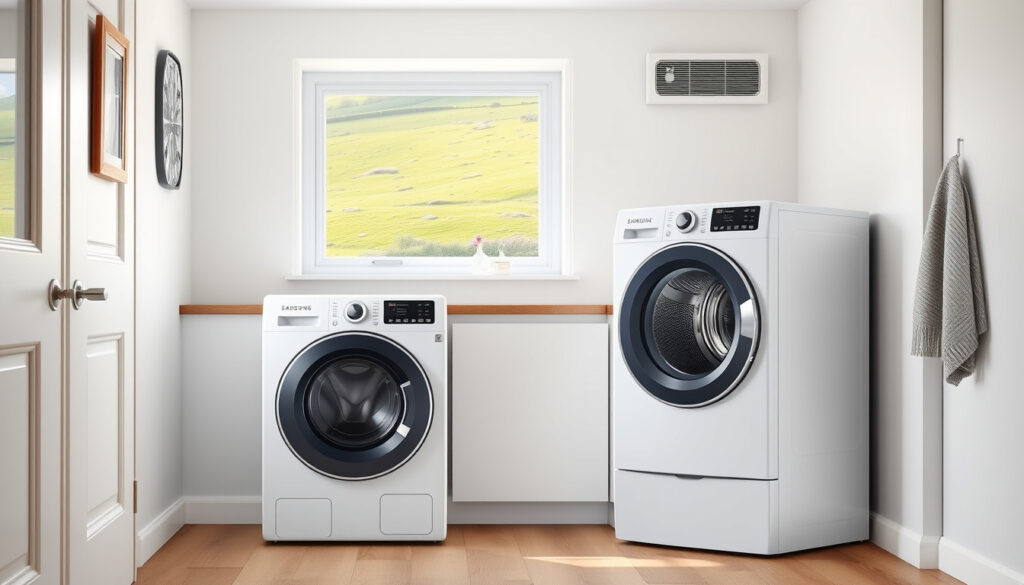
Samsung Heat Pump Dryer: Reviews, Specs & Ireland Guide
Samsung’s heat pump dryers promise lower electricity bills and gentler fabric care — but across Irish households, the same complaint surfaces: loads that seem to run forever and clothes that still feel clammy when the cycle ends. This guide cuts through the marketing to examine what Samsung’s heat pump technology actually delivers, where the performance gaps lie, and whether these machines make sense for Irish homes shopping at Currys or DID.
Capacity: 9kg · Cycle Time: Under 3 hours · Hygiene Care: 99.9% germs removed · Models: Series 5, Series 6 · Vibration: Minimal even at full loads
Quick snapshot
- Samsung heat pump dryers rated 8.5/10 overall whichwasher2007 YouTube Review
- Drying performance comparable to mainstream brands whichwasher2007 YouTube Review
- Series 5 and 6 models available at Currys.ie and DID.ie Samsung Ireland Support
- Exact Ireland pricing varies by retailer and model
- Long-term reliability data from independent Irish household testing
- Warranty claim frequency specific to Ireland service centres
- Long drying times and damp laundry after extended cycles Overclockers UK Forums
- Heat pump dryers run slower than condenser or vented alternatives Telegraph Best Tumble Dryers
- Series 6 continues Samsung’s multi-sensor approach for load detection Samsung Ireland Support
- OptimalDry feature aims to reduce over-drying and improve efficiency Coolblue Advice
| Attribute | Value |
|---|---|
| Capacity | 9kg |
| Type | Heat Pump |
| Key Feature | OptimalDry |
| Hygiene | 99.9% removal |
| Support Page | Samsung.com/ie |
Are Samsung heat pump tumble dryers good?
Samsung’s heat pump dryers sit in the mid-to-premium range of the Irish market, competing against established names like Bosch and Miele. The DV7 (7kg), DV8 (8kg), and DV9 (9kg) series offer solid build quality, and the brand earns credit for including features that some competitors charge extra for. A detailed review gave these dryers an overall rating of 8.5 out of 10, recommending them with caveats around reliability and filter maintenance.
Key features
Series 5 and newer models from Samsung include three dedicated sensors — moisture, temperature, and heat — that work together to detect load dampness and adjust cycle time automatically. The 9000 series adds AI Dry sensors, which Samsung claims provides more energy-efficient and fabric-conscious drying. Hygiene Care cycles reach high enough temperatures to remove dust mites and pollen Coolblue Advice, a point especially relevant for households with allergy sufferers.
The wool dry cycle maxes out at 40°C and accommodates up to 2kg of woolens, which is competitive with other heat pump models on the Irish market.
User satisfaction
Owner feedback across forums and retailer reviews tells a split story. On the positive side, Samsung dryers earn praise for quiet operation — both the 9000 and 8000 series run very silently Coolblue Advice — and for the AirWash feature that freshens clothing without a full cycle. Build quality also draws fewer complaints than Samsung’s washing machines and dishwashers, which have faced more durability scrutiny.
- Users in Irish homes report minimal vibration even at full loads
- Compact models (4.0 cu ft) work well in smaller utility spaces
- The matching washer-dryer sets appeal to buyers wanting consistent aesthetics
The catch is filter maintenance. Newer Samsung dryers lack the sponge filter design found in earlier models, which can lead to clogging over time and noticeably longer drying cycles. Samsung Ireland’s official support page identifies a clogged lint filter as the most common cause of air temperature sensor errors.
Ireland availability
Major retailers Currys.ie and DID.ie stock Series 5 and Series 6 models across multiple capacity options. Samsung Ireland maintains a dedicated support portal at samsung.com/ie with error code listings, troubleshooting steps, and a local service centre directory for warranty claims.
What is the downside of a heat pump dryer?
Heat pump technology brings real energy savings, but those gains come with trade-offs that buyers should weigh before handing over their money. The fundamental issue is physics: heat pump dryers work by reheating and recycling air rather than venting it, which means drying cycles are significantly longer than condenser or vented alternatives.
Longer drying times
The most frequent complaint from Samsung heat pump dryer owners echoes across forums and reviews: loads that take 3 hours or longer, with laundry still coming out damp. One forum user described their experience bluntly — the dryer is “very quiet but useless,” with laundry taking “forever to dry and usually after 3+ hours is still damp.” This is not an isolated report; the Telegraph’s tumble dryer guide specifically flags that heat pump models are slow, calling it a “popular complaint about low energy heat pump tumble dryers.”
- Half-load efficiency: 9kg models handle 4.5kg effectively; 8kg models handle 4kg
- Full loads under 3 hours is typical, but not guaranteed across all fabric types
- Overloading compounds the problem significantly
A clogged lint filter does not just reduce efficiency — it directly triggers error codes and extends drying times by forcing the dryer to work harder to move air. Samsung Ireland’s support page lists lint filter issues as the leading cause of the DC error code.
Higher upfront cost
Samsung’s heat pump models carry a higher purchase price than condenser or vented alternatives. For Irish households on a tight budget, the upfront premium can take years to recoup through energy savings — and that calculation depends heavily on usage frequency. One analysis notes that heat pump dryers have higher component wear, more expensive repairs, and disposal costs that may partially offset those energy savings over the machine’s lifetime.
Maintenance needs
Beyond regular lint filter cleaning, heat pump dryers require occasional maintenance of the heat exchanger. Samsung Ireland lists error code HC as the signal to clean the heat exchanger and check for a clogged lint screen or restricted vent. These maintenance tasks add to the overall cost of ownership and require owner attention that condenser dryers demand less frequently.
Heat pump vs condenser dryer: which is best?
Choosing between heat pump and condenser technology means prioritising either ongoing energy costs or daily convenience. Both approaches have merit; the right choice depends on how your household actually uses a dryer.
Efficiency differences
Heat pump dryers like Samsung’s series recycle hot air rather than venting it, consuming significantly less electricity per cycle. Samsung’s 9000 series with AI Dry sensors exemplifies this approach — the technology adjusts energy use based on real-time load moisture detection. Condenser dryers, by contrast, heat air and vent moisture into the room, requiring more energy per cycle but completing loads faster.
- Heat pump dryers use roughly 50% less energy than condenser models
- Condenser dryers typically finish full loads 30-40% faster
- Heat pump models work well in poorly ventilated spaces since they don’t vent moisture
Cost comparison
The upfront price gap between comparable Samsung heat pump and condenser dryers typically runs €100-200, depending on the series. For an Irish household running three to four loads per week, the energy savings from a heat pump model can recover that difference within two to three years. However, if repair costs arise — which tend to be higher for heat pump components — the total cost of ownership calculation shifts.
For Irish households prioritising lower electricity bills and sustainable operation, heat pump technology makes the stronger long-term case. For those who value speed above all else and have good laundry ventilation, a condenser model eliminates the long wait times that frustrate so many heat pump owners.
Samsung UK insights
Samsung’s UK comparison resources highlight that heat pump dryers suit households running frequent smaller loads, where the gentler cycling and energy efficiency provide clear advantages. Condenser models appeal more to those who prefer quick turnaround and don’t mind the higher energy consumption.
Why does my Samsung dryer take 3 hours to dry?
Three hours for a full load sounds excessive — and it is frustrating. But the reasons behind those marathon cycles usually come down to preventable factors rather than a defective machine.
Load size impact
Your 9kg Samsung dryer is designed for up to 9kg of dry laundry, but filling it to capacity works against the heat pump technology. The sensors need adequate air circulation between garments to measure moisture accurately; an overstuffed drum causes uneven drying and triggers longer cycles as the machine works to achieve the target dryness level. Samsung specifies effective half-load handling: 4.5kg for 9kg models, which often completes in under two hours.
- Never fill beyond the drum’s maximum capacity line
- Separate heavy items like towels from lighter fabrics
- Shake out garments before loading to improve air circulation
Program selection
Not all Samsung cycles are created equal. The OptimalDry feature found in Series 5 and Series 6 models uses the moisture, temperature, and heat sensors to optimise drying time. Running a cycle without engaging these smart features can result in unnecessarily long runtimes. The Hygiene Care cycle, while effective at removing allergens, operates at higher temperatures that extend cycle duration.
Filter and vent maintenance
Samsung Ireland’s official error code guide names the lint filter as the primary culprit when drying times climb. The DC error code specifically signals a check of the lint filter assembly. Beyond the removable filter, the heat exchanger requires periodic cleaning — failure here triggers the HC error code. In Ireland’s climate, cold water tank connections can also freeze in unheated utility spaces, triggering the 9C1 error and interrupting drying performance.
Why are my clothes still damp after Samsung heat pump dryer?
Pulling damp laundry from what should be a finished cycle feels like being shortchanged. The issue typically traces back to one of three causes — and all three are owner-correctable without a service call.
Overloading issues
When too much laundry fills the drum, the centre of the load never receives adequate airflow. The outer layer dries; the inner layer stays wet. Samsung’s heat pump dryers need space for air to circulate between items, so even if the total weight falls within the machine’s rated capacity, tight packing creates the same problem. Try reducing loads to 70-80% of the maximum capacity for consistently dry results.
Filter cleaning
Clogged filters restrict airflow, causing the dryer to run longer without achieving the target dryness level. Samsung Ireland’s support documentation identifies lint filter buildup as the most common cause of air temperature sensor errors that compromise drying performance. After every load, remove and clean the lint filter. Every few weeks, check behind the filter for accumulated lint that doesn’t strip away with routine cleaning.
Sensor calibration
Samsung’s 5000 series and newer include three sensors that detect moisture levels, but these sensors can lose accuracy over time. Residue from fabric softener sheets, dryer sheets, or certain detergent residues can coat the moisture sensors. Running a dry towel through a maintenance cycle or wiping the sensor strips inside the drum with a damp cloth can restore accurate readings. For persistent sensor issues, Samsung Ireland recommends contacting their local service centre.
- Use fragrance-free, dryer-safe fabric sheets if using any
- Wipe sensor strips monthly to prevent residue buildup
- Verify load weights match the selected program before starting
Samsung Ireland specifically notes that the child lock setting can cause unexpected behaviour if inadvertently engaged, including paused cycles that resume mid-run or apparent sensor failures. Checking this setting resolves some reported damp-clothes complaints without any physical intervention.
The model comparison below shows how sensor technology and cycle times shift across the Samsung lineup, which matters most depends on your laundry habits.
| Model series | Sensor technology | Noise level | Typical full-load time |
|---|---|---|---|
| Series 5 | 3-sensor (moisture, temperature, heat) | Quiet | Under 3 hours |
| Series 6 | 3-sensor + OptimalDry | Quiet | Under 3 hours |
| Series 8000 | Multi-sensor, silent operation confirmed | Very silent | Under 3 hours |
| Series 9000 | AI Dry sensors | Very silent | Varies by load |
| Compact | Sensor Dry | Quiet | Varies by load |
These specifications give a clear picture of how Series 5, Series 6, and the Compact model stack up against each other on the key dimensions Irish buyers care about.
| Specification | Series 5 (DV9BTA020) | Series 6 (DV90DG52A0) | Compact (DV25B6900HW) |
|---|---|---|---|
| Capacity | 9kg | 9kg | 4.0 cu ft (approx 3.5kg) |
| Type | Heat Pump | Heat Pump | Heat Pump |
| Energy rating | A++ | A++ | A++ |
| Sensors | Moisture, temperature, heat | Moisture, temperature, heat + OptimalDry | Sensor Dry |
| Noise level | Quiet operation | Quiet operation | Quiet operation |
| Wool cycle max | 2kg at 40°C | 2kg at 40°C | 1kg at 40°C |
| Error codes | DC, HC, 9C1 | DC, HC, 9C1 | DC, HC, 9C1 |
| Ireland availability | Currys.ie, DID.ie | Currys.ie, DID.ie | Specialty retailers |
Upsides
- Energy-efficient operation reduces ongoing electricity costs
- Quiet performance even at full loads — suitable for open-plan homes
- Multi-sensor technology in Series 5 and 6 optimises drying automatically
- High-temperature Hygiene Care removes dust mites and pollen
- Available at major Irish retailers with local warranty support
Downsides
- Longer drying cycles than condenser alternatives — 3+ hours for full loads
- Requires regular filter maintenance to avoid extended runtimes
- Higher upfront cost than condenser models
- Newer models lack sponge filter design, making clogging more likely
- Heat exchanger cleaning needed periodically to prevent HC errors
“they still suffer with the same kind of ball problems as the washing machine does to a degree I nowhere near as often.”
— whichwasher2007, YouTube Reviewer (detailed model-specific review)
“it is slow, which is a popular complaint about low energy heat pump tumble dryers.”
— Telegraph Review Editors (expert tumble dryer guide)
“The laundry takes forever to dry and usually after 3+ hours is still damp.”
— Anonymous User (Overclockers UK Forums owner review)
For Irish households currently comparing heat pump dryers at Currys or DID, the decision point comes down to a straightforward question: are you willing to invest in regular maintenance and accept longer cycle times in exchange for lower energy bills and quieter operation? Samsung’s Series 5 and Series 6 models deliver solid performance when kept clean and loaded properly, earning their 8.5/10 rating from independent reviewers — but that rating depends heavily on owner behaviour. Skip the filter maintenance, and these dryers become the frustratingly slow, damp-clothes machines that populate the complaint forums. Commit to the maintenance routine, and they perform as marketed.
Related reading: Hot Water Heat Pumps
Frequently asked questions
Is a dryer supposed to dry for 40 minutes?
Cycle length varies significantly by dryer type and load size. Condenser dryers often finish cycles in 40-60 minutes. Heat pump dryers like Samsung’s typically require 1.5 to 3 hours for full loads. A 40-minute cycle usually indicates a small or half-load program on a condenser model — not a heat pump machine.
How long does a Samsung heat pump dryer take?
Samsung heat pump dryers typically complete full loads in under 3 hours under normal conditions. Half loads often finish in 1.5-2 hours. Factors that extend this time include overloading, clogged filters, dirty heat exchangers, and using high-temperature Hygiene Care cycles.
What is Samsung Heat Pump Dryer Series 6?
Series 6 is Samsung’s mid-generation heat pump dryer line featuring the OptimalDry system, which uses multiple sensors to detect load moisture and adjust cycle time automatically. Available in 8kg and 9kg capacities, Series 6 models are stocked at major Irish retailers including Currys.ie and DID.ie.
Where to buy Samsung heat pump dryer in Ireland?
Series 5 and Series 6 Samsung heat pump dryers are available at Currys.ie and DID.ie, which offer in-store collection, delivery, and warranty support across Ireland. Samsung Ireland’s official website at samsung.com/ie provides retailer links and local service centre contacts.
Does Samsung heat pump dryer have a manual online?
Samsung Ireland’s support portal at samsung.com/ie provides downloadable manuals, error code guides, and troubleshooting documentation for all current heat pump dryer models. Search by model number (e.g., DV90DG52A0AEEU or DV9BTA020AE/EU) to access the relevant manual.
What programs are on Samsung 9kg heat pump dryer?
Samsung 9kg heat pump dryers include cotton, synthetics, delicates, wool (2kg max at 40°C), mixed load, and hygiene care cycles. Series 5 and 6 models add an OptimalDry program that uses sensor feedback to determine ideal cycle length. AirWash quickly freshens clothing without a full cycle.
More related posts
 Julia Louis-Dreyfus – Biography, Emmys, Family, Net Worth
 Proxy vs VPN: What’s the Difference? Key Pros & Cons
 Find a Grave NZ: Free Online Cemetery Records Search Guide
 Blood and Bone Fertilizer – NZ Gardening Guide
 New World Gate Pa: Opening Hours, Location, and Online Shopping
 OPI Nail Polish NZ: Where to Buy, Best Shades & Prices (2025)
 iPhone 15 Case NZ: Compare Prices at Kmart, JB Hi-Fi & More
 Seed Round: Definition, Size, and How It Works